Showing posts with label maths. Show all posts

Thursday, 29 September 2011

Truth or Lie: Activity for any classroom

Chiew on iasku Blog Challenge truth or lie

I recently responded to a blog challenge by a video recording of myself - you can see it by clicking here. Most EFL teachers are probably aware of the activity where students are asked to say some things about themselves, and the others are to guess if they're true or false.

I suggested taking this a step further and have the students bring video recordings of themselves saying those things.

But, you can take it yet another step further. Although this activity is popular in the EFL classroom, there's no reason why it can't be used in the other classes, too. The topic doesn't need to be personal; it could be on anything. Examples:
  • What is a tangent, or an apex? (Geometry/Art)
  • They could describe an animal or an ecosystem. (Science)
  • They could talk about the rules of rugby. (PE)
  • They could talk about countries, or climate. (Geography)
As you can see, the limit is the extent of your imagination! Try it and let us know!

Tuesday, 22 March 2011

Flipping Education With Technology: A Must-Watch Video

The Khan Academy happened almost by accident. It all started when its creator, Salman Khan, made a video tutorial for his cousins. You can find out what happened after that by watching this video. Khan, quite rightly, received a long standing ovation, and I must admit I haven't been so thrilled about education since Sir Ken Robinson's talk.

Khan's proposal, which wasn't his really, but was started by some of his early followers, is simply to reverse the teaching process. Use video as self-instruction at home, and bring what used to be homework into the classroom, where teachers spend more time with individual students, rather than explaining theories to 30 children. Khan's approach would also work well for students who want to supplement their learning while taking online courses.

The idea is, indeed, very exciting, especially for those of us who have been propagating the use of technology in teaching. It has been tested in some schools, and the result have been very encouraging.

Watch the video, and tell us what you feel. Spread the word - tweet this, post it on Facebook, etc.


Barnes and Noble NOOK eBook Reader (WiFi only) [ Black & White ]Kindle 3G Wireless Reading Device, Free 3G + Wi-Fi, 3G Works Globally, Graphite, 6" Display with New E Ink Pearl Technology
 

Wednesday, 10 November 2010

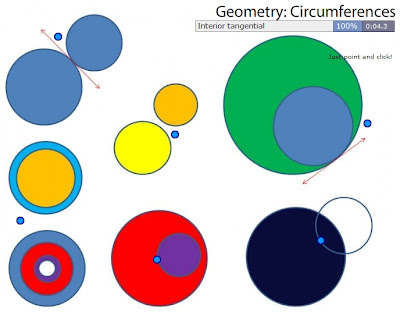
Geometry in Art: Circumference Game

This is just a quick game to help you familiarise/remember the terminology used to describe circles/circumferences.


Chiew's ESL EFL CLIL Games Activities Blog: Geometry - Circle Circumference Terminology

Thursday, 4 November 2010

Geometry: Circle Terminology

Here's something to help you with circle terminology. Please register over at Purpose Games, and leave a comment here whenever you've played any of my games there.


Chiew's CLIL EFL ESL Blog: Geometry in Art - Circle Terminology

Sunday, 21 March 2010

Line Symmetry: video, quizzes, and online jigsaw puzzle

Da Vinci's Vitruvian Man
Last updated: 22 March 2010

Symmetry is covered in different subjects, for example, mathematics, science, technology, and humanities, but for the majority of us, the most familar form of understanding symmetry is geometrical symmetry. Within geometrical symmetry, there are also different types, the most familiar being line symmetry and rotational symmetry.

This post will deal only with 2-dimensional line symmetry.

If we draw an imaginary line across an object, and one side of it is the mirror image of the other, the object is said to have line symmetry; this imaginary line is called the 'line of symmetry'. Line symmetry is also known as reflection symmetry, mirror symmetry, mirror-image symmetry and bilateral symmetry.


butterfly: line symmetry
Flag of Spain: line symmetrySome objects, such as a butterfly, have only one line of symmetry; others have more than one.

We can see many examples of symmetry around us every day, for example, animals, traffic signs, cars, buildings and, of course, the human form itself.


Chiew's CLIL EFL Blog: Line Symmetry


Watch this video on symmetry by clicking on the image below. Due to copyrights issues, I am unable to embed the video here, but when you click on the image you will be directed to the video on Youtube.


Gemetric shapes symmetry quizPut your knowledge of symmetry to the test with this activity on geometric shapes. Click here to begin.
acLiLtocLiMB line symmetry quiz. Photo: Morten Hammer
And now, try this quiz. Your email is required; you will get the results together with the corrections sent to you. Click here to begin.


Taj Mahal online jigsaw puzzle
And if you enjoy a jigsaw puzzle challenge, try this 60-piece Taj Mahal puzzle. Click here to begin.

When you've done all the activities, please come back here to comment. Thanks. Have fun learning!


online line and radial symmetrical practice
Practise axial and radial symmetrical drawing online on this site. It's in Spanish though.

Friday, 11 December 2009

Working with fractions: How to find the Least Common Multiple or the Greatest Common Factor?


Check your skills on fractions with this quiz. If you score below 70%, you probably need to do a little more revision first! Read until the end of this post and retry the quiz.

Fractions, as you probably already know, are numbers that represent part of a whole, e.g. 1/2 (one half) or 2/5 (two fifths). The number above the slash (/) is known as the numerator, and the number below is known as the denominator. The objective of this post is to revise a few basic concepts of calculating fractions before attempting the quiz which follows. If you are unfamiliar with maths terminology, here's an excellent interactive dictionary.

To multiply fractions, we just need to multiply the numerators together, and the denominators together, then reduce the resulting fraction:

5/6 x 5/8 = 25/48

4/5 x 5/6
= 20/30
= 2/3

To divide fractions, turn the fraction you are dividing by (divisor) upside down, then multiply:

3/8 ÷ 3/4
= 3/8 x 4/3
= 12/24
= 1/2

3/4 ÷ 3
= 3/4 x 1/3
= 3/12
= 1/4

To add or subtract fractions with the same denominator, we perform the arithmetical operation on just the numerator, and leave the denominator as it is:

3/8 + 7/8
= 10/8
= 1 2/8
= 1 1/4

7/8 - 3/8
= 4/8
= 1/2

However, if the denominators are different, we must first convert the fractions into equivalent fractions with the same denominators. To do this, it is useful to find the lowest common multiple of the denominators.

BASIC METHOD

The least common multiple (LCM) (also known as lowest common multiple or smallest common multiple) of two numbers is the smallest number that is a multiple of both of them. A multiple of a number can be divided into the number without a remainder.

For example,

multiples of 4 are:

4, 8, 12, 16, 20, 24, 28, 32, 36, 40, 44, ...

(add 4 to each to get the next multiple).

Multiples of 6 are:

6, 12, 18, 24, 30, 36, 42, 48, 54, 60, 66, 72, 78, ...

(add 6 to each to get the next multiple).

Common multiples of 4 and 6, therefore, are numbers that are found in both lists:

12, 24, 36, 48, ....

The least common multiple, as you can see, is 12.

3/4 + 5/6
= 9/12 + 10/12
= 19/12
= 1 7/12

This is the very basic method of calculating the LCM. However, if you need to calculate the LCM of 2 big numbers, this method is not very convenient. So, we look at another way of calculating it. Let us find the LCM of 18 and 54.

VENN DIAGRAM

First, we need to find the prime factors of these 2 numbers. Prime factors of a number are the prime numbers that divide into that number exactly, without leaving a remainder. The process of finding these numbers is called prime factorization:

18 = 2 x 3 x 3
54 = 2 x 3 x 3 x 3

We now draw a Venn diagram, which is a diagram of two circles intersecting another. We write all the factors that these two numbers have in common in the intersection (2, 3, 3). We write the unique factors of 18 on the left circle (none) and those of 54 on the right (3).


To find the least common multiple, multiply all the numbers we see in the diagram: 2 x 3 x 3 x 3, which gives 54.

To calculate the greatest common factor (also known as the highest common factor or the greatest common divisor), we multiply only the numbers in the intersection: 2 x 3 x 3, which gives 18.

Here's another example. Let us take a look at the numbers 48 and 180. Breaking them down, we have:

  48 = 2 x 2 x 2 x 2 x 3
180 = 2 x 2 x 3 x 3 x 5

We see that the common factors of these two numbers are 2, 2, and 3.
The resulting Venn diagram is as such:


The least common multiple is, therefore, 2 x 2 x 2 x 2 x 3 x 3 x 5, which equals 720.
The highest common multiple is 2 x 2 x 3, which equals 12.

The highest common multiple is useful for simplifying fractions, e.g. 48/180. Dividing both the numerator and the denominator by 12 will give the answer 4/15.

Example: 3/48 + 15/180

To be able to calculate this, we need to convert these fractions to have a common denominator, which we know from our previous calculation to be 720:

So, we divide 720 by 48 (the denominator), which gives us 15. We then multiply this by the numerator, 3, to give the answer 45.

3/48 = 45/720

Likewise, we divide 720 by the denominator, 180, to give 4. Multiplying this by the numerator, 15, we get 60:

15/180 = 60/720

3/48 + 15/180
= 45/720 + 60/720
= 105/720

Friday, 16 October 2009

Mean, Median and Mode. Elementary Maths (1ºESO & 2º ESO) Video & Game

Hello everyone! Watch this video on mean, median and mode, and learn the song, so you can impress me in our next class! Besides, if you learn the words, you'll remember how to differentiate between the three terms. When you've done that, test yourself with the simple game that follows.


The lyrics for the song:

Mean, median and mode
How do you find the mean?
Add up the numbers in the data set
Divide the total by the number of items
The answer is the mean or average

Mean, median and mode
But how do you find the median?
Arrange the numbers in order
From the lowest to the highest values
The middle number is the median
For an odd number of items
The average of two middle numbers
Is the median for an even number of items

Mean, median and mode
How do you find the mode?
Just find the number that repeats most often
And that number is the mode
If you find no number that repeats most often
Then there is no mode
Mean, median and mode

I'll explain the examples shown in the video:

Mean:

Data: 1, 8, 6, 4, 6

Add up all the numbers in the set: 1+8+6+4+6, which gives the answer 25. There are 5 numbers in the set. You calculate the mean (also known as average) by dividing 25 by 5, which gives the answer 5.

Median:

Using the same data, you arrange the numbers in ascending order: 1, 4, 6, 6, 8. Since there are 5 numbers (which is an odd number), the one in the middle is 6 (1 and 4 to the left of it, and 6 and 8 to the right). So, 6 is the median.

If, however, there are 4 numbers (which is an even number) 1, 4, 6, 6, you'll have to add the 2 middle numbers, which, in this case, is 4+6. Then, you divide the answer by 2: 4+6=10. 10 / 2= 5. So, 5 is the median here.

Mode:

The mode is basically the number which repeats most often. In our example, the number that repeats most often is 6 (repeats twice). If there aren't any numbers which repeat (e.g. 1, 8, 6, 4), then we say that there isn't any mode.

Let's test if you've understood the concept by playing this game. Have fun learning! Oh, and don't forget to submit a comment so I know you've been here!