Which do you use?
Showing posts with label lesson plans. Show all posts
Thursday, 18 April 2013
How do you teach English?
Kaplan surveyed more than 500 ESL teachers from around the world to discover what tools they use to enhance their lessons. Here's an infographic they created to show the results.
Which do you use?
Which do you use?
Labels:
games,
grammar,
infographic,
lesson plans,
movies,
music,
survey,
tenses,
video
Saturday, 12 May 2012
What would you do if...?
| Image by Chiew Pang |
At first, I just walked past. Later I thought, what if...
And I started fantasizing about the briefcase holding wads of crisp bills...
Then the language teacher ego took hold of me and said, hell, there's an awful lot of possibilities there for a conversation lesson, full of lexical challenges.
So, what would you do if you saw something like this? Ponder over it while I go back to my fantasies...
This image is part of the Project 366 series. If you're involved in it, (and if not, why don't you start?) please let us know in this Google Doc. My images are in Flickr, free for non-commercial use as long as they are properly attributed.
Labels:
activities,
advanced,
conditionals,
conversation,
daily routines,
dogme,
elementary,
grammar,
intermediate,
lesson plans,
make sentences,
past simple,
photos,
speaking,
tenses,
vocabulary,
writing
Tuesday, 14 February 2012
Project 366: What's cooking?
![]() |
| Images by C. Pang. More of the same here. |
Yeah, what's cooking, people? Literally and non-literally. Do you know that to be cooking can mean to be happening or planning (often secretly)?
In case you're wondering...mmm... how come only 7 photos? You may be thinking that I haven't been able to keep up with the project. Well, you're wrong! Here's 36 from February. To see more, click here.
Why there are only 7 in the first mosaic is to do with my lesson idea to go with these images. Set a task for your students. Write K-I-T-C-H-E-N on the board. Their task is to take pictures of what they can find in their kitchen beginning with those letters. Scroll back to the top image - can you guess the names of those objects?
Answer:
Knives, iodised salt, tea canisters, cereals, heat, eggs and nuts.
When they bring in their photos, they compare them with each other's collection. What's the most common? The most unusual? Check vocabulary, check spelling.
How far you can take this lesson depends on the level of your class. Here are some suggestions:
- Who cooks in the family?
- Do you eat in the kitchen?
- What's the size/shape of your kitchen? Describe it.
- Which is your favourite meal?
- How many meals do you eat in a day? What do you eat?
- What is your favourite food?
You can take it a step further like this (I got this idea from Brad Patterson, although his may be a little different): Mine is CLIL-influenced. ;-) Think ecosystem. Instead of you asking the question, get the students to do it after demonstrating it first.
What did you have for breakfast?
Ham sandwich and a coffee with milk.
Where does the milk come from?
Cows.
What do cows eat?
Grass.
What does grass need to grow?
Water.
Where does water come from?
And on and on it goes.
You can do cooking verbs (click to see an example), and if yours is an advanced class, you can venture into idioms (such as "If you can't stand the heat, get out of the kitchen) and phrasal verbs (cook up). I have quite a few activities on idioms. Go to the index file, and search (Ctrl F) for "idioms".
Food is a topic you can do so much with. You can have them write their own recipes (good for imperatives and linking words), you can discuss food expenditure, health, marketing, etc.
If this is successful with your class, you can, naturally adapt this for the other rooms of the house. You may like them to do my activities on Objects in the house either before taking the photos or after. For other activities go to the index file, search (ctrl F) for "houses".
For other ideas on using images in the classroom, search for "Project 366" or "Images" in the index file.
Labels:
activities,
advanced,
art,
basic,
CLIL,
conversation,
dogme,
elementary,
food,
intermediate,
lesson plans,
lists,
photos,
speaking,
vocabulary
Thursday, 2 February 2012
Project 366: The First Month
Wow! I've made it through the first month without missing a day. Every day I've tried to shoot a few photos but not all made it to the page. The lack of control over my automatic constantly frustrated me! To see the mosaics better, click on the images or if you wish to see the individual photos, January's lot are here.
Would you use any of these photos in your lessons?
Here's an idea for you. Beam these images up on the screen. Have the students work in small groups. Ask them to invent a character or characters, then choose 7 photos, and write up a story of a week in the life of their imaginary personality or personalities.
When they finish, they read their stories out to the rest of the class. Post it here if you wish!
For more ideas on using images, go to the index file of this blog and search (ctrl F) for "images" or "Project 366".
Sunday, 22 January 2012
Project 366: The Third Week
Yes, that's right, 21 days have flown past and on the last count, 84 photos in my Project366 folder in Flickr - that's not counting those that didn't make it that far! Here's a selection from the third week.
Lesson ideas?
Divide class into seven groups, and randomly allocate 1 photo each (throw a dice, for example). First, elicit all the words they can think of, words which, in their mind, they can associate with the image. Get them to explain later. You (and the students) may think, oh, we've got #3, the worst. What can we say?
That's where critical thinking comes into play. Water and tiles might come into mind, right? I can think of a multitude more: rain, raindrops, dew, transparent, wet, cold, lines, squares, geometry, wall, window, glass, damp, humid, blue, colourless, odourless, etc, etc... get the gist?
Then, use their image to describe a mini story either orally (can be spoken, sung, rapped...) or written (prose, poetry, lyrics...)
Review by asking a group to describe another group's contribution.
Saturday, 14 January 2012
Lesson idea: Internet shopping
Here are some photos I took partly for purpose of proof, and partly for Project 366, but it occurred to me that they would act as a springboard for an interesting lesson or two. I am just going to suggest a few possibilities, but the way the lesson will flow depends on your students and you.
Topics
Internet shopping
Technology
Digital piracy
Home entertainment
Leisure activities
Grammar
Conditionals (If I could afford it... If my purchase arrived like this... If they had packed it properly...)
Modals
Vocabulary
bubble foam
flimsy
merchandise
refund
bear (the cost)
compensation
Expressions
I would appreciate it if...
I would be grateful if you could...
Would it be possible for me to...
I'm sorry to hear that...
Regarding the damaged item...
Under these circumstances...
If you would prefer to return the item...
We look forward to hearing from you soon.
Activities
Oral discussion on topics (go to Index File, ctrl+F, and search on "speaking")
Writing (complaint, request for refund, negotiation for discount)
Role-play (telephone conversation, forum, chat)
Webquests (assign a product [and a budget] and students purchase it: discuss the whys and wherefores later)
Those are just a sample of what could come up in such a lesson. If you have further ideas, you might like to share them here. If you need further spoon-feeding, I'll be here!
Sunday, 27 November 2011
#ELTBITES Challenge: We like to move it, move it
Once in a while I read something and I find myself thinking, "Now, why didn't I think of that?". Well, Richard Gresswell had such an idea. He started a blog, called it ELTBITES, and challenged us:
"Describe an activity that requires no more than the teacher, students, and possibly making use of the board, pens, and paper. Describe the activity aims and procedure concisely in no more than 200 words."
Here is my contribution, which may not be all that original.
| Image from ELTPics by @yearinthelifeof |
Time: as long as interest prevails
Material: your tongue, and students who obey instructions
Aims: vocabulary, warmer, filler, exercise, fun, ...
Procedure:
This is a simple activity to get the students moving, but, be warned, it can be addictive. I had students wanting to do it again and again, but, perhaps, it was just an excuse for them not to do any 'school work'! ;-)
Think of the language you want your students to work with. Say, you want to revise colours and clothes:
Those of you whose bedroom is white, stand up. (Notice use of relative pronoun, imperative.)
Remain standing.
What about blue?
And black? (I once had a student who has a black bedroom! Of course, we started a mini-conversation.)
Now, if you're wearing white trainers, sit down.
If you're wearing blue jeans, stand up.
You can vary the movements:
If you don't have a belt on, take one step to the left.
If you're wearing black underwear, take two steps back. (This will raise a lot of sniggers!)
Keep it dynamic. Think of unusual stuff (if you can touch your nose with your tongue...). Get them to observe each other (those who have short curly hair...). With higher levels, think of more challenging questions (those who believe in... those who would like to...).
Basically, the limit is your imagination. Hand the activity over to your students. Get them to ask the questions, and use their own commands. Encourage them to be creative.
If you do use this activity, tell us about it!
Labels:
activities,
advanced,
basic,
blogging,
CLIL,
colour,
conditionals,
conversation,
elementary,
games,
grammar,
intermediate,
lesson plans,
make sentences,
relative clauses,
speaking,
vocabulary
Thursday, 29 September 2011
Truth or Lie: Activity for any classroom
I recently responded to a blog challenge by a video recording of myself - you can see it by clicking here. Most EFL teachers are probably aware of the activity where students are asked to say some things about themselves, and the others are to guess if they're true or false.
I suggested taking this a step further and have the students bring video recordings of themselves saying those things.
But, you can take it yet another step further. Although this activity is popular in the EFL classroom, there's no reason why it can't be used in the other classes, too. The topic doesn't need to be personal; it could be on anything. Examples:
- What is a tangent, or an apex? (Geometry/Art)
- They could describe an animal or an ecosystem. (Science)
- They could talk about the rules of rugby. (PE)
- They could talk about countries, or climate. (Geography)
As you can see, the limit is the extent of your imagination! Try it and let us know!
Labels:
activities,
animals,
art,
basic,
CLIL,
conversation,
elementary,
geography,
grammar,
history,
intermediate,
lesson plans,
maths,
music,
PE,
Science,
speaking,
sports,
video
Monday, 13 June 2011
Sheltering Change, more ideas for your lessons
I've always loved this song (written by Jagger/Richards, and released on the Stones' Let It Bleed album towards the end of 1969), and, as you probably already know, I'm very fond of Playing for Change, too. They are good enough reasons for me to link it here in this blog.
But how can we use it in our lessons, you might ask. Well, think about it and tell me!
I can think of numerous ideas - I'll just give you a few clues.
Before you even start playing the song, look at the title, 'Playing for Change'. What is change? What does playing for change mean? What does this organisation stand for? How did it start?
Then, the title of the song, 'Gimme shelter'. What's 'gimme'? What's shelter? What collocations can you think of? What do you think the song is about?
There is also the caption: It is in the shelter of each other that the people live
Have you heard of it? It's an Irish proverb. What do you think the 'shelter' here refers to? Why the definite article in 'the people'?
Finally, make sure they know what 'sign up' and 'mailing list' are.
So, even before you play the song, there's enough material for a whole lesson, depending on your class.
So, you've played the song; you've rocked the building, the DOS has come to see what's going on..., now what do you do?
Where were the musicians from? Can you name the country and nationality? How many instruments appeared in the video? How many can you name? Webquest: find out the names of those you don't know. Which instrument did you like best? Which performer? Which singer?
Diagnose the lyrics. Focus on phrases such as:
- a storm is threat'ning my very life today
- I'm gonna fade away
- It's such a shot away
- the whole of the third verse
The whole song is very metaphoric. Elicit interpretation. Elicit more examples. Get them to write more verses in groups. Choose the best.
More stuff you can use:
Related posts:
Wednesday, 1 June 2011
Guesting on Teaching Village
Read my analysis of emergent language based on lessons using the above image in my guest post for Barbara Sakamoto's Teaching Village. Thanks, Barb, for the invite.
Related posts:
Friday, 20 May 2011
Every Picture Tells A Story: Let The Students Speak!
Some of you may already know that we have a Twitter "group" which goes by the hashtag #eltpics, and each week we have a 'theme', this week's being Every Picture Tells a Story. These pictures here form part of my contribution to this theme. If you would like to share your photos, read through Sandy's post on how to join us.
In recent weeks, I've suggested ways of using images to get students to speak, and I've given examples of prompts that teachers can use in order to encourage their students to use their imagination. Those are, of course, just ideas which you can either use as they are, or adapt to your style and to that of your students'.
Let us now go a step further, or rather for the students to take a step forward, and the teacher one step back:
- Divide the students into groups of 4 or 6, and within each group, split them further into two.
- There are two sets of images here (Images 1-3, and Image 4). Allow them to select whichever they prefer. Or if they have their own (in their mobile phones, for example), they can use them instead, if they wish. Set them a time limit.
- Using the mind maps I had shown in the previous posts as a guidance, one half of the group prompts the other, encouraging them to elaborate in all the little details (remind them of the 5 senses: sight, hearing, smell, touch, and taste).
- Depending on how they get on, you may wish to reverse their roles: the one prompting before will now do the describing.
- From the description they've imagined, they will then form a story.
- At the end of the time allocated, each group tells the class its version.
- They then decide which story they liked best, which was the most fantastic, the funniest, the least/most plausible, etc.
- For homework, they could write up the story (not necessarily the one they'd invented) to accompany the image.
Image 1
Image 2
Image 3
Image 4
Thursday, 19 May 2011
Cokey Monkey: Lesson Plan for Speaking Lesson on the 3000th ELTPics Image
Image by Kylie Barker
This is my response to Sandy Millin's challenge for the 3000th ELTPics Image: What would you do with this picture in your classroom?
Those of you who had been following the last few posts would have seen my digital mind maps done with the help of Bubbl.us. Unfortunately, the free version only allows a miserable three saved copies, so I had to look for alternatives. Coupled with Sandy's challenge, I decided to kill two monkeys with a stroke: brainstormed my answers to her question and test Mindomo's mind map tool.
You can see the results below. Close the 'Topics Notes', and click anywhere on the mind map and scroll to the left or right to see the rest of the ideas. You can also see the whole thing here. If there are any problems, or if you've got any questions, please let me know. If you have further ideas, or if you're bold enough to try this lesson plan on your students, share your views as comments at the end of this post.
Related posts:
Photos + mind maps = Ideas on a silver platter
Speaking lesson using close-ups
Tuesday, 17 May 2011
Photos + Mind Map = Ideas on a Silver Platter
A few weeks ago, I suggested some ideas for a lesson based on a close-up image - if you've missed it, I suggest you read that first. Click here to read it.
I snapped this shot today, and I thought I'd share some more ideas with you all. Between this and the previous article, I think you'll get an idea how you can start your students speaking on any picture. Ask them to share a picture from their mobile phones, and build a lesson from that. If you use these photos & my ideas for a lesson, don't just stop at the end. Ask your class to bring a photo, preferably one they took, and invent a story around it. This can be done in groups. You can re-distribute the photos at random. When they've finished, they can tell the whole class their story, and, in the end, they can decide which group has invented the best story.
If you prefer to use photos taken by others, you can find more like these in our group ELTPics in Flickr. You can join us in Twitter. Upload your photos with the hash tag #eltpics, and one of the lovely lady moderators will add them to the sets.
I've decided to relay my ideas in the form of a mind map this time. In fact, you can, if you wish, do the mind-mapping activity from scratch with the whole class. Just use my prompts whenever you're stuck. To use this mind-mapping tool, see here.
Photo 1
To zoom in on the map, use your scroll dial, or click on the '+' or '-' sign on the top left. You can then drag the image left and right. If you prefer, click here to see the full version.
Photo 2
Photo 3
Photo 4
If you've used these photos/ideas, please share your experience with others. Perhaps, you even get your students to share their thoughts and feelings.
Related posts:
Thursday, 21 April 2011
Tweeting is for the birds: Hockly vs Waters, IATEFL 2011 Brighton
This, along with the PechaKucha night, must have been the highlights of the IATEFL 2011 Brighton conference. The motion for the ELT Debate was 'Tweeting is for the birds, not for language learning', with Alan Waters speaking for the motion, and Nicky Hockly, against.
Here is an opportunity for those who haven't had the chance of watching a live debate in action to do so. The format of the debate differs slightly from the system I have been advocating for use in the classroom, but the essence remains the same.
Listen out for key points in debating:
- Language style
- Rebuttal
- Support (quotes, statistics, analogies, case studies, etc.)
- Clarity & logic
- Organisation
- Expression & delivery
So, watch this entertaining debate, and I hope it will inspire you to hold one of your own in your class/school. Please read the following:
Related posts
Labels:
activities,
advanced,
CLIL,
debate,
how to,
intermediate,
lesson plans,
speaking,
video
Speaking lesson using close-up images
This lesson has been inspired by Ceri Jones' presentation in IATEFL Brighton 2011, or rather her interview, as I wasn't present in the conference, and her session wasn't recorded. For those of you who would like to watch the recorded interviews or sessions, they are available here: http://iatefl.britishcouncil.org/2011/.
Ceri's idea is basically to start off with a close-up. Speak about this, and gradually, extend the conversation away from the close-up, as though you're zooming out of the image. Ask questions based on the five senses: sight, hearing, touch, smell, taste. I would recommend that you look at her blog to read about her ideas of using images in the classroom.
Although Ceri's idea is just to use the close-up, and that may be sufficient if you have a participative class, you may have to feed your class with parts of the wider image if imagination is lacking in an uninspired group. If you use a high-resolution image, you can start off by zooming in to the section you would like to start off with. Prepare this beforehand since it is better if no-one knows what the 'bigger' picture is to keep the element of surprise alive.
In any case, you should always run through your images before a lesson. I, personally, prefer shots which are slightly underexposed, but these may appear too dark in the class or some pictures may appear too bright. So, be prepared to make minor adjustments to adapt the images to each class.
Here, then, is a close-up image.
Ask them what the picture is. They may or may not be able to guess. If no-one is able to guess, show them the following image, or perhaps, give a few hints.
When they've guessed that it's an eye, here are some examples of questions you could ask:
Is it real?
Is it a photo or a painting?
Is it of a man, woman, or an animal?
What kind of animal? / Is the man handsome? /Is the woman pretty? (Here, you can elicit descriptive adjectives - height, weight, type of hair, complexion, etc).
The idea is to remain flexible; the goal is to get all the students to speak. If they are on a roll, don't stop them. You don't have to show the zoomed-out images.
Are they painted by a male or a female? Age? Are the subjects real of imaginary? Are the paintings side by side? Are they of a male or female? Imagine their hair, their mouths...
At this point, they are likely to have guessed that these are graffiti.
Discuss:
Discuss:
Are they a valid art form? Do you like them? Should they be controlled? Where should they be allowed/not allowed? How should offenders be punished? What type of people paint them?
You can branch out to general art. Do you like art? What kind? Do you draw/paint well? Who draws well? Have they got any work of their own to show the class?
So, are the two girls drawn side by side? What about the old lady (well, maybe it isn't an old lady; anyway, I'm referring to the figure in the background)? Are they all drawn by the same person? What makes you think so? Where do you think these graffiti are? Why do you think so?
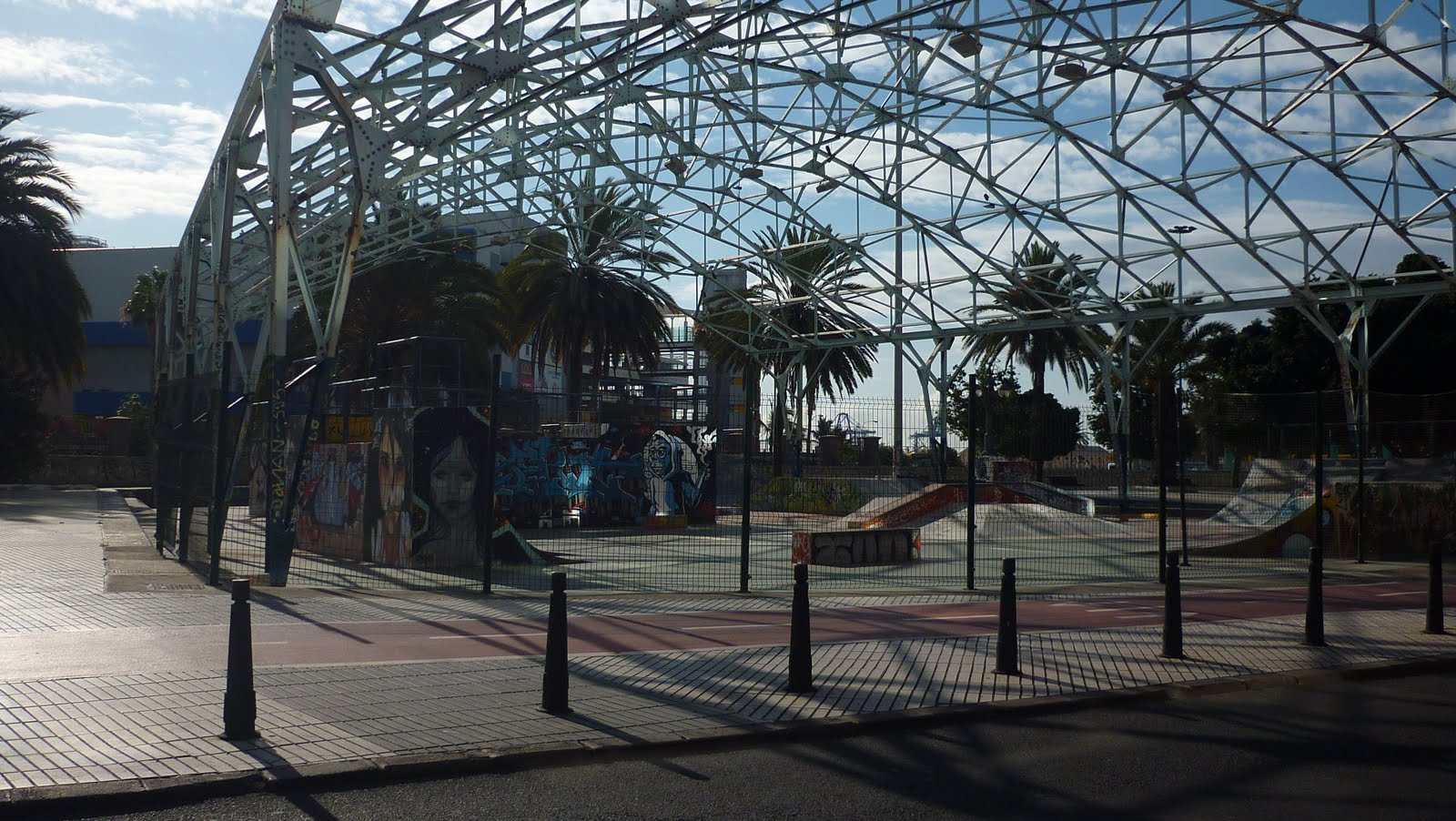
If they haven't guessed already, now they should know that this is a skate park. At this point, whether you've arrived here just by using the first shot, or you've needed to use all the zoomed-out shots, you can start to discuss sports in general, and skateboarding, in particular.
What sports do you practise? How often? Who with? How many? Where? How long? What type of clothes do you wear? Do you have a break? How long? What do you do? What do you do after? Do you chill out somewhere with your friends? Where? What do you talk about?
If they go somewhere to eat/drink - what do you eat/drink? If this subject comes up, you can start to talk about food (remember the five senses). Examples: What's your favourite food? Describe it: colour, texture, taste, smell. Why do you like it? How often do you eat it?
What's your favourite meal time? Do you cook? Who cooks at home? Do you eat healthily? What is healthy food?
Why is there a fence covering the park? What is beyond the park? What is on this side? What's to the left/right? What time of day is it? How do you know? Do you think it gets busy?
Is this picture taken at the same time as the previous? Is this skate park in a city or in a village? What's the weather like?
As you can see, there are endless questions you can ask, and endless topics you can get the students to talk about. If there are too many students in the class, you can split them into groups and have them ask each other questions. Go around monitoring and helping.
Do visit Ceri's blog for more ideas on using images. For sources of image, look at my Useful Resources page, under Images. You can, of course, use our very own ELTpics in Flickr. There, you'll find photos taken by teachers for teachers under the Creative Commons licence. You can also join in the fun by contributing your own photos: tweet the link with the hash tag #eltpics.
Photos are invited for a new topic each week (normally on Sunday). If you don't know the topic, just ask the question with the hash tag, and someone will tell you. You can also contribute photos to older topics - just look at the sets page.
Related topics
Labels:
advanced,
CLIL,
conversation,
how to,
intermediate,
lesson plans,
photos,
speaking,
sports
Monday, 22 November 2010
Using Cartoon Strips to Practise Dialogues
The traditional way of practising dialogue is to have students work in pairs (or groups), prepare their dialogues, then role-play them, maybe in front of the classroom.
Instead of doing that, why don't you get them to prepare a comic strip first (after working on expressions, vocabulary, etc., of course). Either have them do it on the fly in the computer lab, or set it as homework. Later, they can role-play the situations. To make it even more fun, randomly assign the comic strip
to a group for them to act it out.
One of the best I've found is ToonDoo. It's quite versatile; you not only have several characters to choose from, but you can easily play around with backdrops, fonts, expressions, etc. You can bet the kids (and the adults, too) will love it!
What do you think? If you need a tutorial, let me know. Leave your comments below by clicking on 'comments' if you don't see the form.
Subscribe to:
Posts (Atom)