Showing posts with label vocabulary. Show all posts

Friday, 12 December 2014

Memrise - how to create your own "mem"

In Memrise's own words:

What is Memrise?

Memrise is an online learning community where one can learn almost anything in the world, entirely for free! Through just the right mix of science, fun and community, learning on Memrise is speedy, enjoyable and lasts.
Most people I know who have used Memrise love it. It's available both on the web and on mobile devices. The mobile app is still undergoing improvements as I write. I know because I'm helping them test their betas. ;) My recommendation is to use both.

Every so often, I create my own reading/listening activity based on current news and I usually include a lexical exercise. But, as we all know, retaining vocabulary is extremely difficult and most students forget the words they learn almost immediately after.

Since I had some time on my hands, I decided to create a course on Memrise based on these said activities. One of the strongest features of Memrise is their mems (basically, mnemonics) and although I've created a mem or two for each lexical item, my mems very often are just sentences showing how the word was used in the article of the activity.

I encourage students to make their own mems as, really, that's a good way of helping them remember the words, but it seems that many don't understand how it can be done. So, here's a short pictorial tutorial. ;)

Say, you've gone into my course. You'll see something like this.

How to create a mem on Memrise

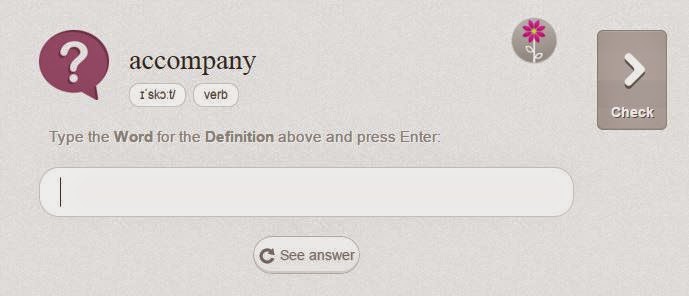
You may choose to review what you remember by clicking on Review, which will bring you to this screen.
How to create a mem on Memrise

Clicking on See answer will bring you to this one.

How to create a mem on Memrise

Now, click on Choose Another Mem.

How to create a mem on Memrise

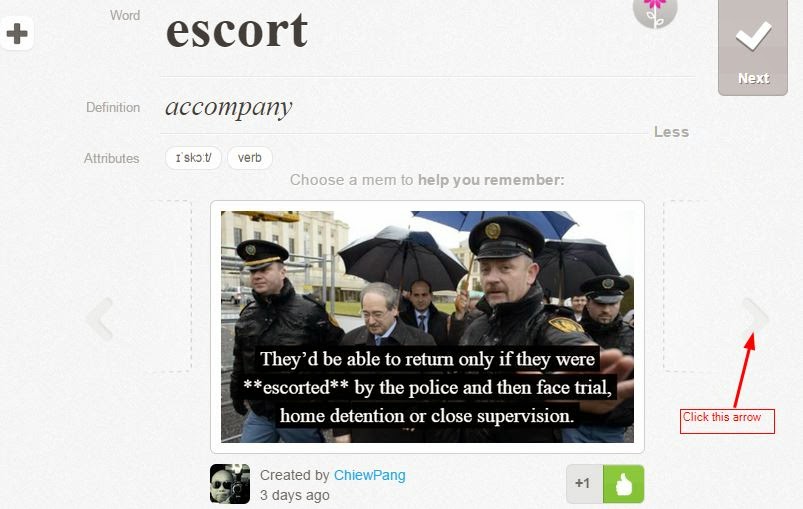
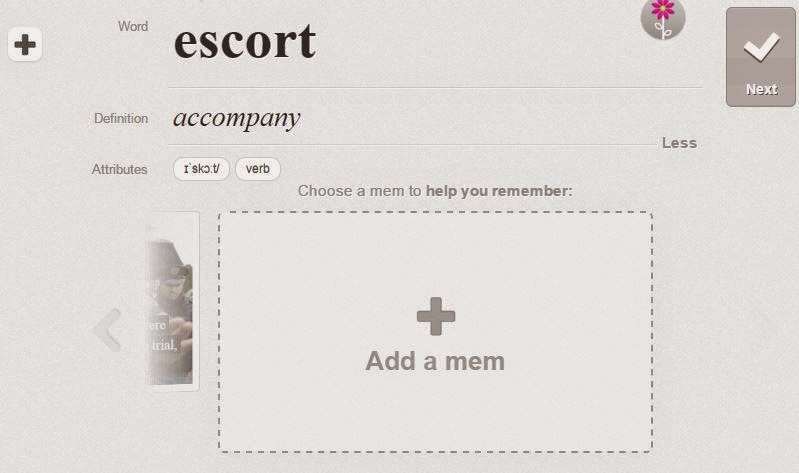
You'll see arrows to the side of the mem. Click the right-facing arrow and you'll see the next one. When there aren't any more, you'll see the following image. I know, at the moment, creating a mem isn't as straightforward as it should be. Hopefully, that will change in the near future.
How to create a mem on Memrise

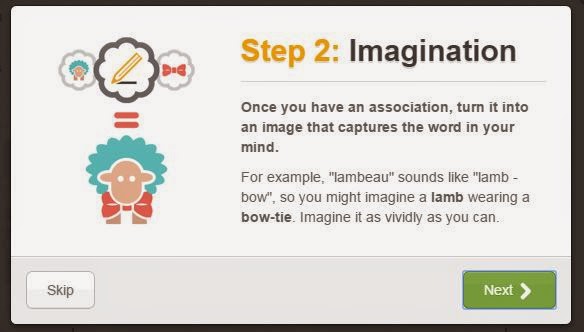
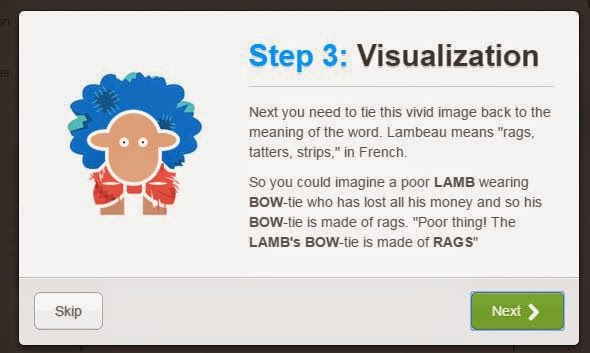
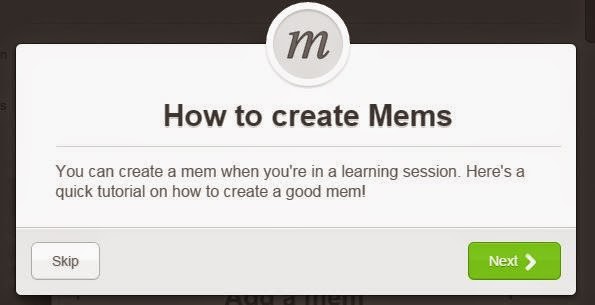
Before clicking on Add a mem, have a look at Memrise's tutorial on creating good mems.
How to create a mem on Memrise

How to create a mem on Memrise

How to create a mem on Memrise

How to create a mem on Memrise

How to create a mem on Memrise

When you click on add a mem, this is what you'll see.

How to create a mem on Memrise

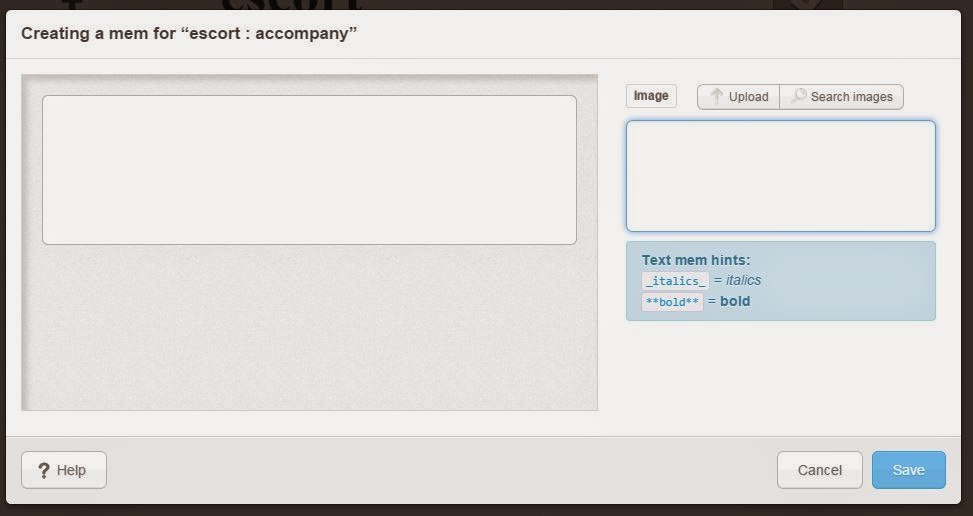
Write any key words you like in the search box and click on search images. When you find one you like, click on it and then save. If you don't want to use any image or you wish to upload your own, skip the search, which will bring you to this:
How to create a mem on Memrise

Type in your text. The bold and italic option only works without images. Don't ask me why.

How to create a mem on Memrise

Click save and you're done. You can modify your mem at a later stage if you like.

I look forward to seeing your mems! Feel free to voice any doubts you may have.


Sunday, 1 June 2014

The World Cup - all the words you need to know

Shunsuke Nakamura taking a free kick
Image by Neier reproduced under the Creative Commons Attribution-Share Alike 3.0 Unported license

"The most direct and enduring way to reach the mind and imagination of the learner is through the mind, imagination and character of the outstanding teacher." Lowell Milken

Well, I don't know if Fabio Capello is an outstanding teacher or not (because I don't agree with his concept of football), but back in 2011, he claimed to be able to reach the mind and imagination of his English players with a mere 100 words.

Cambridge Dictionaries didn't waste any time in reacting and came up with the 100 words here.

However, if you fancy yourself as a top manager, you may want to disagree with Capello, and reach out for the full Cambridge Corpus list of 935 football words.

Meanwhile, contend yourself with looking for the 100 words in this wordsearch. Note that attack appears 3 times! As a noun, as a verb, and it its gerund form: attacking. :D 

And, enjoy the World Cup!

Oh, the way to play it is to click on the first letter of the word, drag it to the last word. However, I think there may be a problem - I used the hyphen in some words and I think it got confused with it. Oh, well, nothing's perfect! Have fun anyway!

Make Your Own Word Search

Sunday, 10 March 2013

Sunday, 1 July 2012

Basic parts of a bicycle

It's been a long time since I created a tagging game, so it's about time I rectify that. Here's one on the basic parts of a bicycle. These are the answers. To play the game, click on the image.


  1. bell
  2. brake lever
  3. stem
  4. cable
  5. top tube
  6. brakes
  7. spoke
  8. fork
  9. valve
  10. flat tyre (puncture)
  11. front reflector
  12. down tube
  13. saddle (seat)
  14. seat post
  15. seat post clamp
  16. seat tube
  17. tyre
  18. chain
  19. crank arm
  20. pedal
  21. rear reflector
ELT CLIL EFL ESOL Bicycle parts game activity

If you need higher-resolution images, click on the following images.

ELT CLIL EFL ESOL Bicycle parts game activity
Image by C. Pang

ELT CLIL EFL ESOL Bicycle parts game activity
Image by C. Pang

Saturday, 12 May 2012

What would you do if...?

ELT ESL EFL CLIL Lesson plans images conversation dogme photos
Image by Chiew Pang
When I saw this...

At first, I just walked past. Later I thought, what if...

And I started fantasizing about the briefcase holding wads of crisp bills...

Then the language teacher ego took hold of me and said, hell, there's an awful lot of possibilities there for a conversation lesson, full of lexical challenges.

So, what would you do if you saw something like this? Ponder over it while I go back to my fantasies...

This image is part of the Project 366 series. If you're involved in it, (and if not, why don't you start?) please let us know in this Google Doc. My images are in Flickr, free for non-commercial use as long as they are properly attributed.

Thursday, 23 February 2012

Project 366: Carnival and other eccentricities

ELT CLIL EFL ESL Carnival photos, ideas, resources
Images by C. Pang. See here for more.
Carnival! Some like it, some don't, but whether you do or don't, you'll most likely associate it with colour, music, fun, dance, Brazil, etc.

So, what's my lesson idea this time?

Aim: Mainly to get the students speaking!
Level: Any
Language: Emergent
Length: As long as a string
Material: Your students' photos

Ask your students to bring in a photo (preferably taken by themselves) associated with carnival, or even better, have them send it to you digitally. Collect them and prepare a mosaic like the image above. You can also set them a webquest task: find out where in the world they have carnival, when they celebrate it and how it got started in the first place.

You can arrange the students in pairs, groups or you can work individually - it depends on the size of your class.

Each student chooses one image. They describe it without saying which. The others try to guess.

Then, they're asked why they chose that particular photo.

Further discussion: Do they like carnival? Why? Why not? Do they dress up? What disguises have they used? What was the latest? What was their favourite? What's the most popular costume this year? What's the most popular ever, in their opinion? For example, in the Canaries, I think the most popular is men dressing up as women, but in a vulgar and grotesque manner: one of the images in the mosaic is a typical case. Oversized bust, badly painted lips, torn stockings, and generally, they make sure they can be easily identified as men: beard, moustache, hairy legs, etc.

What other festivals are there in which people dress in fancy costume? Do they (the students) participate in these? Why do people like to disguise themselves? What about safety in these occasions? Are there usually problems? Have they ever been involved in one?

Written task: Write about their choice of image as discussed in class.

Have you got any other great ideas?

Tuesday, 14 February 2012

Project 366: What's cooking?

ELT EFL ESL CLIL Blog Lesson idea using images for speaking, writing
Images by C. Pang. More of the same here.

Yeah, what's cooking, people? Literally and non-literally. Do you know that to be cooking can mean to be happening or planning (often secretly)?

In case you're wondering...mmm... how come only 7 photos? You may be thinking that I haven't been able to keep up with the project. Well, you're wrong! Here's 36 from February. To see more, click here.

ELT EFL ESL CLIL Blog Lesson idea using images for speaking, writing

Why there are only 7 in the first mosaic is to do with my lesson idea to go with these images. Set a task for your students. Write K-I-T-C-H-E-N on the board. Their task is to take pictures of what they can find in their kitchen beginning with those letters. Scroll back to the top image - can you guess the names of those objects?

Answer:

Knives, iodised salt, tea canisters, cereals, heat, eggs and nuts.

When they bring in their photos, they compare them with each other's collection. What's the most common? The most unusual? Check vocabulary, check spelling.

How far you can take this lesson depends on the level of your class. Here are some suggestions:
  • Who cooks in the family?
  • Do you eat in the kitchen?
  • What's the size/shape of your kitchen? Describe it.
  • Which is your favourite meal?
  • How many meals do you eat in a day? What do you eat?
  • What is your favourite food?
You can take it a step further like this (I got this idea from Brad Patterson, although his may be a little different): Mine is CLIL-influenced. ;-) Think ecosystem. Instead of you asking the question, get the students to do it after demonstrating it first.

What did you have for breakfast?
Ham sandwich and a coffee with milk.
Where does the milk come from?
Cows.
What do cows eat?
Grass.
What does grass need to grow?
Water.
Where does water come from?
And on and on it goes.


You can do cooking verbs (click to see an example), and if yours is an advanced class, you can venture into idioms (such as "If you can't stand the heat, get out of the kitchen) and phrasal verbs (cook up). I have quite a few activities on idioms. Go to the index file, and search (Ctrl F) for "idioms".

Food is a topic you can do so much with. You can have them write their own recipes (good for imperatives and linking words), you can discuss food expenditure, health, marketing, etc.

If this is successful with your class, you can, naturally adapt this for the other rooms of the house. You may like them to do my activities on Objects in the house either before taking the photos or after. For other activities go to the index file, search (ctrl F) for "houses".

For other ideas on using images in the classroom, search for "Project 366" or "Images" in the index file.


Thursday, 26 January 2012

Part 24 Idioms (Money) Infographic & Interactive Game

Take a look at this superb infographic from Grammar.net, study the idioms, then put yourself to the test by playing the game (click on the image below the infographic). If you would like to see the detailed explanations, go here. For more on idioms, go to the index file in Google Docs and scroll down until you see the heading Idioms.

[Infographic provided by Grammar.net]


For more on idioms, use the tag to search.

Sunday, 22 January 2012

Project 366: The Third Week

Yes, that's right, 21 days have flown past and on the last count, 84 photos in my Project366 folder in Flickr - that's not counting those that didn't make it that far! Here's a selection from the third week.

Lesson ideas?

Divide class into seven groups, and randomly allocate 1 photo each (throw a dice, for example).  First, elicit all the words they can think of, words which, in their mind, they can associate with the image. Get them to explain later. You (and the students) may think, oh, we've got #3, the worst. What can we say?

That's where critical thinking comes into play. Water and tiles might come into mind, right? I can think of a multitude more: rain, raindrops, dew, transparent, wet, cold, lines, squares, geometry, wall, window, glass, damp, humid, blue, colourless, odourless, etc, etc... get the gist?

Then, use their image to describe a mini story either orally (can be spoken, sung, rapped...) or written (prose, poetry, lyrics...)

Review by asking a group to describe another group's contribution.


Monday, 28 November 2011

UG2BK - Hinglish, Chinglish & Singlish?

This is so hilarious I've just got to share it here, too. Shame it's so fast that learners may have a hard time following it. Anyway, just sit back and try to enjoy it: The History of English in 10 minutes!


Sunday, 27 November 2011

#ELTBITES Challenge: We like to move it, move it

Once in a while I read something and I find myself thinking, "Now, why didn't I think of that?". Well, Richard Gresswell had such an idea. He started a blog, called it ELTBITES, and challenged us:

"Describe an activity that requires no more than the teacher, students, and possibly making use of the board, pens, and paper. Describe the activity aims and procedure concisely in no more than 200 words."

Here is my contribution, which may not be all that original.

Image from ELTPics by @yearinthelifeof
Level: any
Time: as long as interest prevails
Material: your tongue, and students who obey instructions
Aims: vocabulary, warmer, filler, exercise, fun, ...
Procedure:

This is a simple activity to get the students moving, but, be warned, it can be addictive. I had students wanting to do it again and again, but, perhaps, it was just an excuse for them not to do any 'school work'! ;-)

Think of the language you want your students to work with. Say, you want to revise colours and clothes:

Those of you whose bedroom is white, stand up. (Notice use of relative pronoun, imperative.)
Remain standing.
What about blue?
And black? (I once had a student who has a black bedroom! Of course, we started a mini-conversation.)

Now, if you're wearing white trainers, sit down.
If you're wearing blue jeans, stand up.

You can vary the movements:

If you don't have a belt on, take one step to the left.
If you're wearing black underwear, take two steps back. (This will raise a lot of sniggers!)

Keep it dynamic. Think of unusual stuff (if you can touch your nose with your tongue...). Get them to observe each other (those who have short curly hair...). With higher levels, think of more challenging questions (those who believe in... those who would like to...).

Basically, the limit is your imagination. Hand the activity over to your students. Get them to ask the questions, and use their own commands. Encourage them to be creative.

If you do use this activity, tell us about it!

Thursday, 24 November 2011

Stand By Me, Japan

This is a good an excuse as any to listen to a good song, and, at the same time, be reminded of the suffering the great nation had to endure earlier this year.

Why not use this video as a springboard for a class discussion on natural disasters, for example?

You might like to read this post on activities using songs.


Sunday, 25 September 2011

Adjectives with -ed and -ing endings, but how about relaxed and relaxing?

ELT ESL EFL CLIL Grammar Adjectives -ed -ing

Most learners very quickly grasp the concept of the difference between adjectives ending in -ed and those ending in -ing. They would have been told that adjectives ending with -ed describe our feelings and those ending with -ing describe what cause the feelings in the first place.

Compare:

We were bored out of our minds in today's class.
Today's class was terribly boring!

Suzanne was terribly interested in what Pedro had to say.
Pedro was saying some very interesting stuff.

I was all right until he started explaining about learning theories, then I got totally confused.
I found his explanation of learning theories very confusing.

More often than not, these adjectives describe emotions and feelings. For more examples and activities, click here.

However 'relax' sometimes generates doubts.

Although we can say "I feel very relaxed working in here; it's got an extremely relaxing atmosphere" to mean I'm relaxed working in here because the atmosphere is relaxing, a relaxed atmosphere and a relaxing atmosphere can actually mean two different things.

Relaxed could mean informal, comfortable, cozy, lenient, easygoing, free from tension, calm while
relaxing refers to a feeling of physical or mental rest.

So, a relaxed atmosphere doesn't necessarily mean a relaxing atmosphere. Imagine a scenario where you work in an office where it's generally very relaxed - you can dress how you wish, working hours are flexible, managers' doors are always open, etc, but you may be an odd fish and actually find this way of working contrary to your perception of work, and, as a result, don't find working here very relaxing!

Do you agree? Can you think of other adjectives like this?

You might also like this: http://aclil2climb.blogspot.com.es/2010/04/adjectives-of-emotions-and-feelings-ed.html

Monday, 13 June 2011

Sheltering Change, more ideas for your lessons

I've always loved this song (written by Jagger/Richards, and released on the Stones' Let It Bleed album towards the end of 1969), and, as you probably already know, I'm very fond of Playing for Change, too. They are good enough reasons for me to link it here in this blog.

But how can we use it in our lessons, you might ask. Well, think about it and tell me!

I can think of numerous ideas - I'll just give you a few clues.

Before you even start playing the song, look at the title, 'Playing for Change'. What is change? What does playing for change mean? What does this organisation stand for? How did it start?

Then, the title of the song, 'Gimme shelter'. What's 'gimme'? What's shelter? What collocations can you think of? What do you think the song is about?

There is also the caption: It is in the shelter of each other that the people live
Have you heard of it? It's an Irish proverb. What do you think the 'shelter' here refers to? Why the definite article in 'the people'?

Finally, make sure they know what 'sign up' and 'mailing list' are.

So, even before you play the song, there's enough material for a whole lesson, depending on your class.


So, you've played the song; you've rocked the building, the DOS has come to see what's going on..., now what do you do?

Where were the musicians from? Can you name the country and nationality? How many instruments appeared in the video? How many can you name? Webquest: find out the names of those you don't know. Which instrument did you like best? Which performer? Which singer?

Diagnose the lyrics. Focus on phrases such as:
  • a storm is threat'ning my very life today
  • I'm gonna fade away
  • It's such a shot away
  • the whole of the third verse
The whole song is very metaphoric. Elicit interpretation. Elicit more examples. Get them to write more verses in groups. Choose the best.

More stuff you can use:


Related posts:

Tuesday, 17 May 2011

Photos + Mind Map = Ideas on a Silver Platter

A few weeks ago, I suggested some ideas for a lesson based on a close-up image - if you've missed it, I suggest you read that first. Click here to read it.

I snapped this shot today, and I thought I'd share some more ideas with you all. Between this and the previous article, I think you'll get an idea how you can start your students speaking on any picture. Ask them to share a picture from their mobile phones, and build a lesson from that. If you use these photos & my ideas for a lesson, don't just stop at the end. Ask your class to bring a photo, preferably one they took, and invent a story around it. This can be done in groups. You can re-distribute the photos at random. When they've finished, they can tell the whole class their story, and, in the end, they can decide which group has invented the best story.

If you prefer to use photos taken by others, you can find more like these in our group ELTPics in Flickr. You can join us in Twitter. Upload your photos with the hash tag #eltpics, and one of the lovely lady moderators will add them to the sets.

I've decided to relay my ideas in the form of a mind map this time. In fact, you can, if you wish, do the mind-mapping activity from scratch with the whole class. Just use my prompts whenever you're stuck. To use this mind-mapping tool, see here.

ESL ELT ESOL ELL CLIL Games, Resources, Activities, Lesson Plans
Photo 1

To zoom in on the map, use your scroll dial, or click on the '+' or '-' sign on the top left. You can then drag the image left and right. If you prefer, click here to see the full version.


ESL ELT ESOL ELL CLIL Games, Resources, Activities, Lesson Plans
Photo 2

ESL ELT ESOL ELL CLIL Games, Resources, Activities, Lesson Plans
Photo 3

ESL ELT ESOL ELL CLIL Games, Resources, Activities, Lesson Plans
Photo 4

If you've used these photos/ideas, please share your experience with others. Perhaps, you even get your students to share their thoughts and feelings.

Related posts:

Sunday, 15 May 2011

Is this the best interactive multilingual dictionary?

ELT EFL ESL ESOL CLIL Resources, Games, Activities: Learn while you browse

When Russell Stannard says Lingro is the best site he's discovered this year, then one can't help but to sit up and take notice. And took notice was what I did and duly put it through its paces. Russell, as usual, has done a fantastic training video on it, and you can watch it here.

Lingro is basically a dictionary, but a dictionary with a difference. It's almost like having a dictionary beside you while you surf the web, except searching is almost instant. Here are its features:
  • It allows you to load a web page, or a document (.txt, .doc or .pdf)  and it makes all words of the page clickable.
  • It claims to have 8 million translations in 11 languages.
  • If you just want a plain old dictionary, it claims to be the fastest multilingual dictionary on the web. Definitions appear as you type.
  • It remembers all the words you look up, allowing you to review and study them
  • It also keeps the sentences in which the word you looked for appeared
  • You can also play games with your stored words
  • You can organise your words into different lists
  • If a word isn't in the dictionary, you can collaborate by adding the meaning. I've already added some.
Russell was right, Lingro is indeed fantastic. However, perfection doesn't exist, so expect the odd problem here and there, such as occasional sluggish response (especially in Chrome - the problem Chrome has with Flash is quite well-known). Here are a few other reservations I have:
  • Although you can browse around a website within Lingro, you'll have to remember that to follow a link, you'll need to click the little green button which appears above the link you hover over, and which says 'Click here to open link', because, if you click on the original link, it will presume you're looking for the meaning of the word you happen to click on!
  • It is only capable of looking up single words, not phrases, nor even phrasal verbs.
  • Each time you look up a word, it's stored on your word history, even if you'd already looked it up before. Allow me to explain. Imagine you looked up the word 'consigna'. Maybe you clicked on it twice. You go to your word lists page, and you'll see 'consigna' in your word history list. You drag it to your 'Spanish' list. Then, maybe you click it again, just to check. Now, you drag the word from the history to the bin as you've already kept it on your 'Spanish' list. But, you'll find that the word is still on the history list! That's because since you've clicked on it a total of 3 times, you'll have to drag it to the bin 3 times! Somewhat of a pain, really.
  • The sentence history is on a separate page. It would make more sense to be able to see the sentences together with the word list.
Remember that to be able to save your words, you would need to log in. I had trouble finding where to do it! It's placed (misplaced, more like it) at the bottom right.

ELT ICT ELL CLIL EFL ESL Tools, Resources, Using Lingro multilingual dictionary

Thanks to Russell Stannard for discovering this site. To try Lingro, click here. I think learners would love this site!

Out of Our Minds: Learning to be Creative    Out of Our Minds: Learning to be Creative    Delta Teach Dev: Teaching Unplugged: Dogme in English Language Teaching

Monday, 9 May 2011

Idioms Part 23 (Food - Pie/Potato) Interactive Game

I can't believe that almost a month has passed since my last idiom activity!

We're still on food; this time we'll take a look at pies & potatoes.

as easy as pie

It means just that - extremely easy. Sometimes, you'll hear 'easy as apple pie': That test we did today was really easy as pie, wasn't it?

eat humble pie

When you eat humble pie, you admit your error and apologize (normally): I was forced to eat humble pie when I mistakenly accused him of stealing my mobile phone; he had one exactly like mine, but mine was in my back pocket the whole time!

have one's finger in the pie

- to be involved in something. Often, you'll hear this version:

have one's fingers in too many pies

This happens when you're involved in so many things that you're unable to do any of them well: My son has his finger in too many pies; I told him to just concentrate on one course instead of having to divide his time among the five he's doing right now.

pie in the sky

This refers to a plan or an idea that is rather far-fetched, and is unlikely to bear fruit: All his ideas had been previously dismissed as pie in the sky until he came up with his brilliant add-on to Twitter.

slice of the pie

To want a slice of the pie is to want a part of what is being shared. This expression is used mainly in the USA; the UK equivalent is slice of the cake: This year's education budget has been reduced dramatically, so each school will have a smaller slice of the pie.

couch potato

Originally, this is used to refer to someone who spends a lot of time on the couch (sofa) watching television, but now, it refers to anyone who leads a sedentary lifestyle: You're such a couch potato! It's about time you start doing something other than sitting in front of your computer screen all day!

drop (someone or something) like a hot potato

- to stop being involved with someone or something due to problems. Sometimes, you will hear 'drop like a hot brick' instead: He was dropped from the team like a hot potato when he was seen with the team manager's daughter.

small potatoes

This expression is used mainly in the US. In the UK, it's more common to hear 'small fry'. 'Small beer' also has the same meaning: something or someone unimportant or insignificant: He acts as though he's a big shot in the company, but, in fact, he's nothing but small potatoes.

meat and potatoes (mainly US)

These are the most important or the most basic parts of something. It's also used as an adjective to refer to someone with ordinary tastes, or something that is very basic:

The meat and potatoes of any computer is the RAM.
Sue gave a meat-and-potatoes explanation of the new camera, but everyone understood.

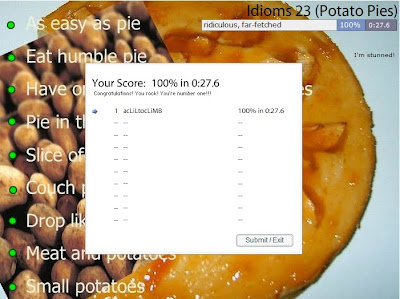
Now that you've learned these idioms, put your knowledge to the test on this interactive activity. Click the image below to begin. Although it isn't necessary, registration at Purpose Games will allow you to keep track of your scores. Have fun!

ELT EFL ESL CLIL Resources, Activities, Games: Potato and Pie Idioms

Be sure to check out the rest of this series on idioms. Go to the index file and search (ctrl F) for 'Idioms'.