Showing posts with label past simple. Show all posts

Saturday, 12 May 2012

What would you do if...?

ELT ESL EFL CLIL Lesson plans images conversation dogme photos
Image by Chiew Pang
When I saw this...

At first, I just walked past. Later I thought, what if...

And I started fantasizing about the briefcase holding wads of crisp bills...

Then the language teacher ego took hold of me and said, hell, there's an awful lot of possibilities there for a conversation lesson, full of lexical challenges.

So, what would you do if you saw something like this? Ponder over it while I go back to my fantasies...

This image is part of the Project 366 series. If you're involved in it, (and if not, why don't you start?) please let us know in this Google Doc. My images are in Flickr, free for non-commercial use as long as they are properly attributed.

Thursday, 24 November 2011

Stand By Me, Japan

This is a good an excuse as any to listen to a good song, and, at the same time, be reminded of the suffering the great nation had to endure earlier this year.

Why not use this video as a springboard for a class discussion on natural disasters, for example?

You might like to read this post on activities using songs.


Wednesday, 13 April 2011

A Day In The Life: One Song, Countless Activities: Simple Past Cloze, Phrasal verbs, Vocabulary, etc.


ELT EFL ESL CLIL TEFL Resources, Games, Activities: Simple Past gap-fill activity

In We Are The Champions, I wrote about several ideas you could do with songs in the classroom, so if you'd missed it, you ought to take a look now.

Warm-up

Play the video, freeze it when Paul McCartney can be seen. Ask if anyone knows him, what they know: the group he belonged to, the instrument he plays, the period the song was written, etc.

Gap-fill

Play the video once, asking them to listen and, at the same time, watch the images carefully. Then, ask them what images they remember seeing, and if the images suggested anything to them.

Before playing a second time, get them to try the gap-fill activity, without asking for help. Remind them that each time they ask for help (?) or a hint, they lose points.

Phrasal Verbs

Once the gap-fill activity has been successfully completed, explain these phrasal verbs to them (after asking them to guess first):

blow out
turn away
turn on
wake up
get out
look up

As most phrasal verbs have multiple meanings, it's best to stick to what they mean in the context of the song, in order not to overly confuse the students.

blow out: the 'blow' here means to break into pieces and the 'out' gives a sense of outward direction.

   The gas explosion blew out all the windows of the house.

There may be no need to draw attention to the graphic imagery of 'he blew his mind out', but you could perhaps ask how he could have done this (answer: by shooting himself). However, if you want to go deeper, John could have been cheeky with his typical double entendre, and meant that the driver was stoned out of his head!

turn away: although 'turn away' is a phrasal verb meaning to refuse to allow someone into a place, here it isn't used as a phrasal verb as such. 'Away' is used as an adverb meaning towards a different direction.

'A crowd of people turned away' meaning if they were looking at the screen, they stopped looking at it by looking at a different direction.

turn on: mmm...this is a tricky one as one of the meanings has a sexual connotation, even a drug-related one perhaps. What was John thinking of when he wrote it? Depending on the age group of your students, you may wish to explain that it means 'getting someone interested in something'.

wake up: wake or wake up means to stop sleeping.

get out: to get out of bed is to leave the bed, especially after sleeping.

look up: As in 'turn away', the 'up' is used as an adverb to mean towards a higher direction.

'And looking up, I noticed I was late': remembering that he's gone downstairs to have a cup (of tea, probably) (you could also ask them about rooms in the house - he'd obviously went down to the kitchen from his bedroom upstairs), he could be looking back up the stairs, but more likely, he was looking up at a clock on the wall, and saw that he was late.

Analysis and interpretation

One could write a doctorate on this song, really! There are many aspects that can be discussed depending on the level and the age group of your students. You can analyse each line and draw multitudes of hidden layers behind John's irony and sarcasm. You can talk about subjects such as urban life, suicide, drug abuse, fame, politics, and so on. Whether he meant it intentionally or not, there is so much to be read behind John's words (and you could guess which were John's words and which were Paul's).

To put it in a nutshell, discuss the lyrics in class. Ask them for their personal interpretation (or work in groups). Compare interpretations. As homework, set a group webquest - ask them to find out interesting things about the song and prepare a presentation (leave the choice to them: could be PowerPoint, Prezi, Glogster, Vocaroo, Wallwisher, well, whatever tickles their fancy!)

You can also ask them to add another verse based on a piece of news they have read in the newspapers or heard on the TV.

I have also prepared a short quiz, testing rhymes, synonyms, antonyms and phrasal verbs. If you ask your students to enter your email, their results will be sent to you. Alternatively, if you make sure they enter valid references (such as class/school), ask me, and I'll forward their attempts to you.

ELT EFL ESL CLIL TEFL Resources, Games, Activities: Simple Past gap-fill activity

Related posts:

Index of all Material by Category
We are the champions: Present Perfect activities
Conditional Type II with Norah Jones
Conditional Type III with Keith Whitley

Saturday, 4 December 2010

Using Geocam in the classroom

Chiew's ELL EFL ESL CLIL Online Games, resources, activities: Geocam for speaking activities

Geocam has, at the moment, over 1000 cameras stationed throughout the world, constantly streaming images to your computer. You navigate around Geocam as you would in Google Maps. See the image above. Since it's streaming live, it's perfect as a tool to get students speaking in the present continuous. Be warned that since it's streaming images, you'd need a decent internet connection.

Of course, you don't have to restrict yourself to the present continuous. Students can practise the simple present and adjectives by describing the image. You can always ask them to choose the location themselves.

You can work on simple past by freezing a couple of images and asking them to compare the differences. See below.

Chiew's ELL EFL ESL CLIL Online Games, resources, activities: Geocam for speaking activities


You can practise predictions (future or past, depending on the point you freeze the images) as in the picture below:

Chiew's ELL EFL ESL CLIL Online Games, resources, activities: Geocam for speaking activities

What do you think they had been doing/are going to do? (Actually, the baby had to pee!)

It can also be used to demonstrate differences between countries, such as the time, the weather, etc.

If you have other interesting ideas on how to use Geocam in the classroom, please do share them with us here. 


I stumbled upon Geocam @ Ana Maria's Blog


Get Chitika | Premium    Get Chitika eMiniMalls

Saturday, 22 May 2010

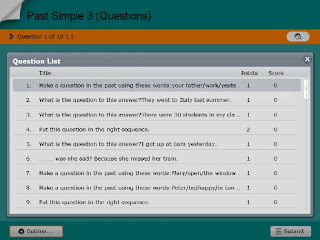
Past Simple 3 Quiz (Questions)


Here's another quiz for you to practise your simple past tense, but this time, it's focussed on questions. Remember that the correct answer is always given; so if you get it wrong, try to understand your error and keep on doing the quiz!

Teachers, please note that if students provide a valid email, the results will be automatically sent to it.

Chiew's CLIL EFL ESL Games and Activities Blog: Past Simple Questions Quiz

Wednesday, 12 May 2010

Past Simple Quiz 2

An easy past simple quiz to help you with your revision. Remember that the correct answer is always given; so if you get it wrong, try to understand your error and keep on doing the quiz!

Past Simple Quiz

Monday, 3 May 2010

Past Simple Quiz (Elementary); Theme: Explorers


Teachers, please take note: some of my quizzes, like this one, for example, ask for an email. If an email is provided, the results will be sent automatically to it. This allows you to grade/check your students' progress. If you haven't got an email for this purpose, I'd suggest creating one for this purpose, and ask the students to provide that email in the quiz.

Saturday, 10 October 2009

Pronunciation of regular past simple verbs /id/, /d/ and /t/ (Elementary +) Fun activity!

Most learners of English have problems pronouncing past tenses correctly. Fortunately, there are only three different ways of pronouncing the ending of regular verbs, which can be expressed by the phonetic symbols of /id/, /d/ and /t/.

Even more fortunately is that of the three, the sound of /id/ is the most obvious, and also the easiest to identify. The past simple of regular verbs ending with the sound of /d/ or /t/ is pronounced with the ending of /id/. Please note that it's the sound and not the letter which you have to pay attention to. For example, depend /dɪˈpend/ --> depended /dɪˈpendid/, want /wɒnt/ --> wanted /'wɒntid/.

If in doubt of the ending sound, consult the dictionary.

To identify when to pronounce the past with a /d/ or a /t/ is somewhat trickier. The rule is that if the ending sound is voiced, it is pronounced with a /d/ and if it is voiceless, it is pronounced with a /t/.

All vowels are voiced, so you 'only' have to worry about the consonants. When you make a voiced sound, your throat vibrates whereas when you make a voiceless sound, it is just air coming out of your mouth. You can hear the difference by trying this test: cover your ears and say 'save' /seɪv/ and 'cough' /kɒf/. You will find that you can feel a vibration at the end of 'save' and not 'cough', which means 'saved' will be pronounced /seɪvd/, while 'cough' will be pronounced /kɒft/.

Try practising the pronunciation of some words using the method mentioned above before attempting this game. The idea is to drag-and-drop each item in the correct bin as fast as you can. If your answer is wrong, you won't be allowed to put the word in that bin, and you'll have to try again.

Have fun!

Note to teachers: you are welcome to use any of the activities found here in this blog. You can have the students do them in the computer lab, or set them as homework and asking them to state their scores in the comments section. If you do the latter, please ask your students to give some information which will allow you to identify them. They don't have to give their surname if they don't want to, but information like their first name, the name of the school, the class, and the teacher's name are all useful identifiers, e.g. Jesús V./4ºA/Rincón/Chiew.

Tuesday, 6 October 2009

Irregular Past Simple Arcade Game (Elementary)

The infinitive form of a verb will be shown at the bottom of the game screen. You then have to click on its past tense/past participle form which appears above. Before you click to start each level, read the past tense forms first. See how fast you can go, and try to get to Level 6! Each time you play, there will be a different selection, so play it as many times as you wish and tell me your best scores!


If you like this game, please link to it by copying and pasting this HTML code (click anywhere inside the box, click ctrl+A, then ctrl+C) into your own blog or web template. This is the badge you'll get:

Games for Education

Thursday, 10 September 2009

Unscramble these jumbled sentences: Idioms (Advanced)

As promised, here's an activity of reordering jumbled sentences based on common idioms. All the sentences (from recent press reports) have appeared as idioms of the day in this blog. If you've been religiously following the blog, you'll recognise most of the sentences; and if you haven't, well, shame on you!
Answers are available in a separate post - you'll just have to look for it!
Have fun learning!
PS: I'm often guilty of writing for readers of reasonable knowledge of IT, but I've come to realise that what is natural to some of us may not be so obvious to others. So, for those of you who haven't figured it out, you can download this PowerPoint slide show by clicking on 'More'. In the pop up menu which appears, select 'Save document'. You may be required to join Scribd first. All that is required to join is a valid email account.
Jumbled Sentence - Idioms (Advanced)

Unscramble these jumbled sentences: Past Simple 2 (Intermediate)

I thought I'd posted this, but I didn't, so here it is. They're all sentences in the simple past, taken from recent newspaper reports.
Answers are available in a separate post - you'll just have to look for it!
Next jumbled sentences activity will be on idioms, so watch out for it!
Have fun learning!
PS: I'm often guilty of writing for readers of reasonable knowledge of IT, but I've come to realise that what is natural to some of us may not be so obvious to others. So, for those of you who haven't figured it out, you can download this PowerPoint slide show by clicking on 'More'. In the pop up menu which appears, select 'Save document'. You may be required to join Scribd first. All that is required to join is a valid email account.
Jumbled Sentence Simple Past-2 (Intermediate Plus)

Wednesday, 26 August 2009

Unscramble these jumbled sentences: Past Simple (Intermediate Plus)

These sentences are extracts from three recent news reports.
First, try to put the jumbled words into the right sequence.
Then, see if you can classify the sentences into the three groups.
When you’ve done that, give each group a headline.
Finally, invent three short reports using the sentences.
Answers are available in a separate post - you'll just have to look for it!
Have fun learning!

Jumbled Sentence Simple Past 1 (Intermediate Plus)