I've published a new page containing links to resources which might be useful to some of you. Note that this page will be very much alive, and will be regularly updated. Feedback, as usual, will be much appreciated. If you still haven't realised, just above this post, you will see a header containing 'Home, Games, Shopping', etc. Click on one of these, and it will bring you to that page.
About a month ago, the great Sir Ken Robinson put out a request on Twitter for us to ask him questions (#askSKR) about education. He has, unsurprisingly, been inundated with questions. He has, so far, published four video responses, with more coming along the way, I would imagine. If you haven't heard about Sir Ken, please do watch this video here:
Q3: How do you feel about the actual subjects covered in school? What should the youth really learn and study? (I personally would replace 'actual' by 'current' and remove the definite article from 'the youth'. Does anyone else share my thought?
Q2: Assessing Creativity
Q1: In January 2004, US college grad's unemployment rate exceeded that of high school dropouts. What does this mean for diplomas and degrees?
Here's a simple presentation on how to draw parallel lines using set squares. This can be downloaded from either Author Stream, Scribd or SlideShare. Thanks goes to José Alberto.
Last published on 15 Nov 2009. This version has been reworked and supersedes the older version.
Do you have trouble making a telephone call in English? Do you get nervous when you don't understand the person on the other end? Are you familiar with most of the basic telephone language? In this post, I will try to help you improve your telephone skills by looking at the most common words and expressions used in telephone conversations followed by some practice. If you have any doubts, please don't hesitate to ask.
Watch this short video and see if you can understand some of the vocabulary used. Then, study the list below, and watch the video again, if necessary.
The problem facing learners in understanding telephone conversations, apart from a general weakness in listening skills, is that there are many ways of saying the same thing, and often, the learner gets confused. Here, I will explain some of the most common words and expressions which you should try to learn.
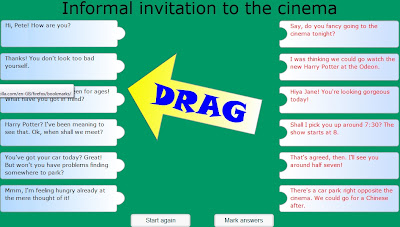
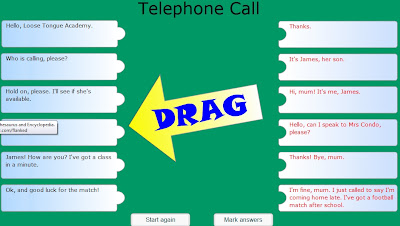
Then watch the video below, and try to fill in the gaps in the lyrics. After that, play the two matching games (click on the images at the beginning of this post). The first is a telephone conversation of someone making an appointment with her hairdresser. The second one is slightly more challenging. For teachers, the idea is for the students to practice matching the dialogue first. Once they get that, you can then have them role play the situation, making some changes, if you like.
answer (to pick the phone up when it rings) answering machine (a machine that answers your telephone and records messages that people leave for you) busy (if someone's telephone is busy, they are using the phone when you try to call) call (= ring, phone, telephone; make a call) caller (the person making the call) call back / phone back (to telephone someone again) cell phone (= mobile phone) cordless phone (a phone which works without a cable connecting the phone to the electric supply) dial (to press the buttons on the phone to make a call) dial tone (the sound which the phone makes when you pick the phone up. Note that most modern phones no longer have this.) directory / telephone directory / phone book (a book containing names, addresses and phone numbers) hang up (to end a call) phone (see 'call' above) phone booth / pay phone / call box (a public telephone where you put in money to make a call) pick up (to answer the phone) receiver (the part of the phone you pick up to hear and speak, especially on an old-fashioned phone) ring (noun: the sound the phone makes, or verb: to make a call)
Answering the phone
Hello? Pizzie's Pizza, how can I help you? The English Academy, good evening, Paul speaking.
Introducing yourself
Hi Linda, it's me, George. Hello, this is Julie calling. Good morning, it's Jane from the hairdresser's here. This is him / Speaking / You're speaking to him (These are expressions used when the caller asks to speak to you, but didn't realise that you were the one he wanted to speak to)
Asking to speak to someone
Informal
Is Jane in, please? Is Jane there, please? Can I speak to your mother, please?
Formal
May I speak to Dr. Jones, please? Is the doctor available, please? Good afternoon, I'd like to make an appointment. Could you put me through to the accounts department, please?
Just a sec (=second). I'll get him. (informal) Hang on one sec / Hang on a mo (= moment) (informal) Please hold the line; I'll put you through to his office. One moment please.
Having problems understanding
Could you spell that for me, please? Could you speak a little slower, please? Could you please repeat that? I'm sorry. My English isn't so good - could you speak a little clearer, please?
Messages
Julie isn't in, I'm afraid. Who's this? (Informal) I'm sorry, but Pedro isn't available right now. Can I take a message? He's busy right now. Would you like to leave a message?
Yes, can you tell her that her husband called? No, that's all right; I'll call back. Yes, could you take my number down, please? It's José from the Jules Academy.My number is ...
Hello, how are you? Have you been all right, Through all the lonely, lonely, lonely, lonely, lonely nights, That's what I'd say, I'd tell you everything, If you'd pick up that _________ .
Hey, how you feelin'? Are you still the same? Don't you realise the things we did, we did, Were all for real, not a dream, I just can't believe, They've all faded out of view
Doo wop, dooby dooby wop, Doo wop, do la la la la la, Blue Days, black nights, Doo wop, do la la la la la
I look into the sky, (The love you need ain't gonna see you through), And I wonder why, (The little things are finally coming true)
_________ line, give me some time, I'm living in twilight, Oh, _________ line, give me some time, I'm living in twilight
OK, so no one's_________, Well can't you just let it ____ a little longer, longer, longer? I'll just sit tight, through the shadows of the night, And let it ____ for evermore
Doo wop, dooby dooby wop, Doo wop, do la la la la la, Blue Days, black nights, Doo wop, do la la la la la
I look into the sky, (The love you need ain't gonna see you through), And I wonder why, (The little things are finally coming true)
_________ line, give me some time, I'm living in twilight, Oh, _________ line, give me some time, I'm living in twilight
This dialogue has a handful of common expressions, which, however, may be unfamiliar to some learners. Try to do the quiz before looking at the explanations below.
gorgeous - an adjective, used for saying something is wonderful or someone is very beautiful, e.g. these prawns are absolutely gorgeous!
You don't look too bad yourself - it'd have meant the same if Jane had said, 'You look good, too.' Here, basically, Jane is politely returning the compliment. She's saying, 'Thank you, but look at yourself - you look good, too.'
Say - an interjection used to get someone's attention before you say something.
fancy - this is used a lot in informal setting. It means 'feel like' or 'want to'. Notice the -ing form. "Do you fancy some ice cream?" "What do you fancy doing this evening?"
ages - a long time. The more correct form would be 'I haven't been to the cinema for ages!' but 'to the cinema' is understood in the conversational context, so it was left out.
What have you got in mind? - What are you thinking of? What plans/ideas have you got? What do you want to do?
thinking, meaning - stative verbs don't normally take an -ing form, but compare the meanings of these examples:
I think it'll be a good film (My opinion is that it will be a good film) I'm thinking of cutting my hair (I have this idea, and this is to cut my hair, although I haven't really decided yet)
Gorgeous means very beautiful (gorgeous can be replaced by the word very beautiful, i.e. they have the same meaning) I've been meaning to call you (My intention was to telephone you)
shall - Although it's becoming uncommon, it is still used quite often in British English for offers, suggestions, requests for instructions, and requests for advice:
What shall I cook for lunch? Not: What will I cook for lunch? Shall I carry your bag? Not: Will I carry your bag? When shall we meet? - Jane is asking for instructions. Could she have said: 'When will we meet?' Yes, though here it would imply that Pete had no idea before, and he would be making a spontaneous decision.
great - has several meanings, but here it is used to express pleasure.
We could go for a Chinese after - What Pete means is that he has the idea of going for a Chinese meal after the show. Again, 'the show' is understood, so it was omitted.
mere - used for emphasis. Just thinking about the Chinese food has already made Jane feel hungry.
half seven - In spoken British English, people often say ‘half one’, ‘half two’ etc, which has the same meaning as ‘half past one’ and ‘half past two’.

 , Shopping
 ', etc. Click on one of these, and it will bring you to that page.

 call in English? Do you get nervous when you don't understand the person on the other end? Are you familiar with most of the basic
  language? In this post, I will try to help you improve your telephone skills by looking at the most common words and expressions used in telephone conversations followed by some practice. If you have any doubts, please don't hesitate to ask.
 and see if you can understand some of the vocabulary used. Then, study the list below, and watch the video again, if necessary.
 (= mobile phone)
 (a phone which works without a cable connecting the phone to the electric supply)
 , how can I help you?
 's here.
 - Telephone Line