Monday, 1 November 2010

Basic Art Material

As some of you may know, animated presentations hosted on Slideshare and Scribd don't display well when embedded. So, I was rather pleased when I realised that they can be seen quite well on Author Stream. This presentation can now be downloaded from these three sites.

Don't forget to read the original post here: http://aclil2climb.blogspot.com/2010/10/basic-art-material.html

Sunday, 31 October 2010

My neighbourhood

Here are a couple more games on places in town series. Be sure to try the other activities, too. Click here.


Chiew's CLIL EFL ESL Blog: Places in Town

Chiew's CLIL EFL ESL Blog: Places of Worship

Thursday, 28 October 2010

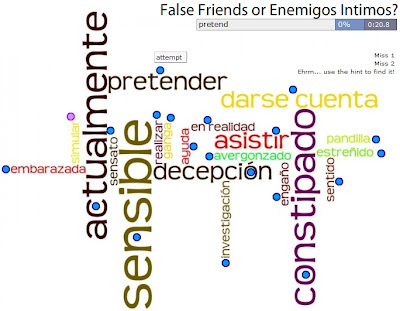
False Friends or Enemigos Íntimos? Examples + Game


Chiew's CLIL EFL ESL Blog: Amigos Falsos


When we are learning a language, we tend to, quite naturally, use familiar-sounding words in a context which we subconciously assume to be correct. This often happens with languages with the same roots like Latin, for example. As we know, many English words are derived from Latin, which is the main source for languages such as French, Italian, Portuguese and Spanish.

Some words, indeed, have similar meanings, but there are many that don't, which can result in rather embarrassing situations.

A Spanish or Portuguese, for example, may say, 'I pretend to assist you in your class', which will find a non-Latin-speaking English teacher responding with a blank stare.

Words like these are known as false cognates, or more commonly, false friends or 'amigos falsos'.

Below are some common examples of Spanish false friends.

actual (SP: present, current; ENG: used to emphasise that something is real, which leads to another false friend as 'real' in Spanish means 'royal'!)

asistir (SP: to attend; ENG: assist = to help)

constipación (SP: a cold; ENG: constipated = have trouble going to the loo, 'estreñido')

decepción (SP: disappointment; ENG: deception = trickery)

dormitorio (SP: bedroom; ENG: a large room where a lot of people sleep)

embarazada (SP: to be pregnant; ENG: embarrassed = ashamed)

en absoluto (SP: not at all; ENG: absolutely = completely)

éxito (SP: success; ENG: exit = way out)

ganga (SP: bargain; ENG: gang = 'pandilla')

historia (although it also means 'history', it is often used to mean 'story', as in 'historia de amor')

investigación (in Spanish, it is also used to mean 'research'; in English, we normally investigate such things as crime and accidents)

librería (SP: bookshop. A library is 'biblioteca' in Spanish. A newsagent or a corner shop can be known as 'estanco')

preservativo (SP: contraceptive; ENG: preservative = 'conservante', and conservative = 'conservador')

pretender (SP: to try; ENG: pretend = fake, 'fingir', 'simular')

realizar (SP: to carry out; ENG: realise = to know and understand, 'darse cuenta')

régimen (In hotels, it is used to refer the type of meal arrangement (board): alojamiento y desayuno = bed and breakfast; media pensión = half board; pensión completa = full board. In English, we used regimen to mean a programme of medical treatment, exercise, or special food for improving your health or appearance. So, a hotel receptionist wouldn't say, 'What type of regimen would you like?')

sensible (SP: sensitive; ENG: reasonable and practical. Sensible in English would mean 'sensato' , 'prudente' or 'razonable')

Click on the image above to play a point-and-click game. Feedback would be most welcome.

If you like this, you may like this one, too: False Friends II

Wednesday, 27 October 2010

a cLiL to cLiMB, New Look

Regular readers might have noticed some changes I've incorporated recently, the most obvious being the new header. It's been a long time coming, but I finally got around to redesigning it and tried to make it look a little trendier. Have I achieved that? Let me know if you like it (or don't)!

Also, I've just installed a cool little tool called Snap Shots that enhances links with visual previews of the destination site. Sometimes Snap Shots bring you the information you need, without your having to leave the site, while other times it lets you "look ahead," before deciding if you want to follow a link or not.

Should you decide this is not for you, just click the Options icon in the upper right corner of the Snap Shot and opt-out.

Finally, I've been avoiding it since I began the blog, but unfortunately, my personal situation dictates that I can no longer afford not to keep this blog ad-free. This blog consumes a lot of my personal time, and my only reward so far has been some personal satisfaction. I hope it will not detract you from your enjoyment, and if you could, any support will be most appreciated.

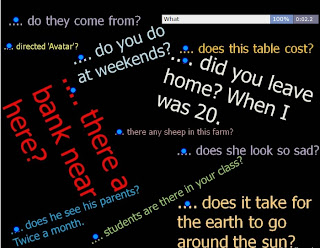
Halloween Q&A Game

Last updated: 27 Oct 2010 22:08, BST (GMT+1)
I forgot to publish the game! Sorry!

A little game to combine questions practice and Halloween! You might also like this post: http://aclil2climb.blogspot.com/2009/10/ideas-for-halloween-in-classroom.html


Chiew's EFL ESL CLIL Blog: Halloween

Tuesday, 26 October 2010

Teaching students to ask questions


Many students have problems structuring questions correctly. It could be that this is due to their teachers asking the questions most of the time, or it could just be that constructing questions in English is somewhat more complicated than in other languages.

Let's run through the main rules again.

First, make sure students know what an auxiliary verb is. An auxiliary verb is a 'helping verb'. It helps another verb (the main one) in the same sentence. Examples are the verb to be, do, have, and the modal verbs, such as can, will, and may:

He is playing football at the moment.
Butterflies can’t bite, but they can fly.
You must speak more English in class.

In a question, an auxiliary verb comes before the subject. If there is no auxiliary, we use DO, DOES or DID. However, DO is not used together when there is another auxiliary verb, e. g. BE.

Do you like hip-hop? (NOT: Like you hip-hop?)
Did you like the film? (NOT: Liked you the film?)
Are you paying attention to me? (NOT: Do you are paying attention to me?)
Is she usually at home in the evening? (NOT: Does she usually is at home in the evening?)

You can answer this type of questions with 'yes' or 'no'.

To ask for more information, we use question words. These usually come at the beginning of the question:

Who said that?
Which is your sister?
Whose pen is this?
What did she want?
Why are you laughing?

We can't answer these type of questions with a yes/no. Remember that we use 'do' only when there are no other auxiliary verbs present.

When the question word is the subject, the question word comes before the verb, and 'do' is not normally used:

Who left the windows open? (NOT: Who did leave the windows open?)
Answer: Cristina left them open. ('Who' asks for Cristina, the subject of the answer)

  How many students want to come to my class? (NOT: How many students do want to come to my class?)
Answer: Seven students want to come to your class.

When a question word is the object, do is used:

Who do you want to speak to?
Answer: I want to speak to the headmaster. ('Who' asks for the headmaster, the object)

What do you think of the film?
Answer: I think the film was wonderful!


NEGATIVES

We make negative verb forms by putting not after an auxiliary:

It is not raining (It isn’t raining).
I can’t swim (I cannot swim).
I’m not Chinese.

Do is normally used if there is no other auxiliary verb:

I like the salad, but I don’t like the soup. (NOT I like not the soup.)
I don’t think Sharon is as friendly as María. (NOT I think not...)

Do is followed by the infinitive without to:

I didn’t think. (NOT I didn’t to think, I didn’t thought, or I didn’t thinking)


To practise, take a look at this mind map. It has been adapted from Karenne Sylvester's, from her article, first published on 20th Oct 2010, on Kalinago English, 'The Easiest Speaking Game In The World'.

Chiew Pang's EFL ESL CLIL Blog: Making Questions

Draw it on the board, leaving the circle (well, all right, it isn't really a circle) in the centre blank. You can play it as a game, dividing the students in groups. It doesn't really require much explanation, but to make sure they understand, put a topic in the middle (something you've been doing with them recently, e.g. music). Ask a student what she thinks is required. Elicit an example. Elicit a few more from other students.

Then, write a list of topics (or elicit from the students themselves) on the board. Assign one topic to each group. Tell them to ask each other questions based on their topic. Discourage written preparation. Encourage them to speak to each other on the fly. Monitor closely.

And, here's a quick online game. Match the question word or the auxiliary to the right question. Please register, if you haven't done so already, before playing the game, and do leave a comment!

Chiew Pang's EFL ESL CLIL Blog: Making Questions