Which do you use?
Showing posts with label tenses. Show all posts
Thursday, 18 April 2013
How do you teach English?
Kaplan surveyed more than 500 ESL teachers from around the world to discover what tools they use to enhance their lessons. Here's an infographic they created to show the results.
Which do you use?
Which do you use?
Labels:
games,
grammar,
infographic,
lesson plans,
movies,
music,
survey,
tenses,
video
Saturday, 12 May 2012
What would you do if...?
| Image by Chiew Pang |
At first, I just walked past. Later I thought, what if...
And I started fantasizing about the briefcase holding wads of crisp bills...
Then the language teacher ego took hold of me and said, hell, there's an awful lot of possibilities there for a conversation lesson, full of lexical challenges.
So, what would you do if you saw something like this? Ponder over it while I go back to my fantasies...
This image is part of the Project 366 series. If you're involved in it, (and if not, why don't you start?) please let us know in this Google Doc. My images are in Flickr, free for non-commercial use as long as they are properly attributed.
Labels:
activities,
advanced,
conditionals,
conversation,
daily routines,
dogme,
elementary,
grammar,
intermediate,
lesson plans,
make sentences,
past simple,
photos,
speaking,
tenses,
vocabulary,
writing
Sunday, 3 April 2011
We Are The Champions: One Song, Countless Activities: Present Perfect Cloze, Idioms, Vocabulary, etc.
A lot of teachers who use songs for ELT restrict themselves to a gap-fill activity plus a singalong, but there are, however, many other activities you could do besides those, some of which I've set out below, and I also created a quiz incorporating some of them.
Due to copyright problems, I'm not allowed to embed the video here, but click on the video image, and then, again, where it says 'Watch on YouTube", and it will bring you to the video in YouTube.
(Note: I just tried it again, and it played the video here without any problem. I won't remove the above warning just in case you get the copyright message.)
Watch the video once. Then, click on the second image to start the interactive cloze activity. Play the video a second time, and while it's playing, try to fill in the missing gaps.
When you've completed that, have a go at the quiz - just click on the third image below to start. Only the email is obligatory, but if you don't wish to enter yours, just give a fictitious one, e.g. a@a.com.
If you provide an email, the quiz robot automatically sends you your results, along with the correct answers.
Due to copyright problems, I'm not allowed to embed the video here, but click on the video image, and then, again, where it says 'Watch on YouTube", and it will bring you to the video in YouTube.
(Note: I just tried it again, and it played the video here without any problem. I won't remove the above warning just in case you get the copyright message.)
Watch the video once. Then, click on the second image to start the interactive cloze activity. Play the video a second time, and while it's playing, try to fill in the missing gaps.
When you've completed that, have a go at the quiz - just click on the third image below to start. Only the email is obligatory, but if you don't wish to enter yours, just give a fictitious one, e.g. a@a.com.
If you provide an email, the quiz robot automatically sends you your results, along with the correct answers.
Ideas for using songs in the classroom for teachers:
Speaking: Play the first few seconds of the song (without the video image). This is a famous song, so chances are that a fair few of the students will know it. Ask them. Ask them what they know: the group, the names of the band members, the song title, how often they have heard the song, where they have heard it, what it means to them, what they think the writer was writing about, etc.
Depending on the level of your students, this song could lead to all sorts of interesting discussions, such as AIDS, struggling artistes, bullying, sports in general, football in particular, success and failure, etc.
Fill-in-the-gap: If you're doing this as an offline activity, have them guess the missing words before they listen to the song.
Jumbled sentences: Cut up the lyrics into strips of phrases, and ask them to put them in the right sequence. Or, you can jumble the words of a bar and they correct them. You can just write the words on the board, or you can prepare a word cloud. Click here to see an example.
Synonyms/Opposites: Ask the meaning and/or opposites for: pay, do, bad, made, come, end, loser, bring, fortune, go, pleasure.
Idioms: This song is great for idioms:
pay one's dues: to earn a given right or position through hard work, long-term experience, or suffering
kick sand in someone's face: to be mean, to insult, to criticise, to bully
take a bow: to say of someone after they have achieved something special
not a bed of roses (usually negative): not easy, not pleasant or good, rough
Rhyming words: Select a word, e.g., 'call', and ask them to think of words which rhyme with it. You can set up a group competition, if you want.
As an extension of the above activity, ask them to invent another verse to add to the song.
Related posts:
Index of all Material by Category
Idioms
Jumbled Sentences: Present Perfect
Cockney Rhyming Slang
Rhyming Words
Word Clouds - 101 Ways of Using Wordle in the Classroom
Related posts:
Index of all Material by Category
Idioms
Jumbled Sentences: Present Perfect
Cockney Rhyming Slang
Rhyming Words
Word Clouds - 101 Ways of Using Wordle in the Classroom
Labels:
activities,
basic,
CLIL,
elementary,
grammar,
intermediate,
listening skills,
music,
present perfect,
tenses,
video
Sunday, 3 October 2010
Daily Routines Tagging Game

Click on the image to test yourself in a simple point-and-click game on daily routines.
If you want to see your name appear on the scoring sheet, you'll have to register before playing. Remember your nickname & password for all my other games which are hosted on Purposegames.
Either way, please leave a comment, stating your score (percentage and time).
Other activities on daily routines you may be interested in:
Unscramble these jumbled sentences
Offline version
Other activities on daily routines you may be interested in:
Unscramble these jumbled sentences
Offline version
Labels:
activities,
basic,
CLIL,
daily routines,
elementary,
games,
grammar,
present simple,
tenses,
vocabulary
Saturday, 22 May 2010
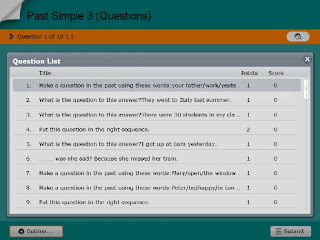
Past Simple 3 Quiz (Questions)
Here's another quiz for you to practise your simple past tense, but this time, it's focussed on questions. Remember that the correct answer is always given; so if you get it wrong, try to understand your error and keep on doing the quiz!
Teachers, please note that if students provide a valid email, the results will be automatically sent to it.
Monday, 22 March 2010
Present Continuous Activities

Here are a few activities for you to practice the present continuous. This one here is a fill-in-the-gap exercise. Use the present simple or the present continuous.Click here to begin.
This activity requires you to put jumbled words in their right order. There is also a dialogue exercise where you have to rearrange the jumbled sentences. Click here to begin.
Please note that there seems to be some bug in the software: when you've finished the quiz, it'll say 'sending email...'. This shouldn't take a long time. If you see that it keeps flashing that message, it's best to force the window to close or you and I will be bombarded with countless emails!
Saturday, 10 October 2009
Pronunciation of regular past simple verbs /id/, /d/ and /t/ (Elementary +) Fun activity!
Most learners of English have problems pronouncing past tenses correctly. Fortunately, there are only three different ways of pronouncing the ending of regular verbs, which can be expressed by the phonetic symbols of /id/, /d/ and /t/.
Even more fortunately is that of the three, the sound of /id/ is the most obvious, and also the easiest to identify. The past simple of regular verbs ending with the sound of /d/ or /t/ is pronounced with the ending of /id/. Please note that it's the sound and not the letter which you have to pay attention to. For example, depend /dɪˈpend/ --> depended /dɪˈpendid/, want /wɒnt/ --> wanted /'wɒntid/.
If in doubt of the ending sound, consult the dictionary.
To identify when to pronounce the past with a /d/ or a /t/ is somewhat trickier. The rule is that if the ending sound is voiced, it is pronounced with a /d/ and if it is voiceless, it is pronounced with a /t/.
All vowels are voiced, so you 'only' have to worry about the consonants. When you make a voiced sound, your throat vibrates whereas when you make a voiceless sound, it is just air coming out of your mouth. You can hear the difference by trying this test: cover your ears and say 'save' /seɪv/ and 'cough' /kɒf/. You will find that you can feel a vibration at the end of 'save' and not 'cough', which means 'saved' will be pronounced /seɪvd/, while 'cough' will be pronounced /kɒft/.
Try practising the pronunciation of some words using the method mentioned above before attempting this game. The idea is to drag-and-drop each item in the correct bin as fast as you can. If your answer is wrong, you won't be allowed to put the word in that bin, and you'll have to try again.
Have fun!
Note to teachers: you are welcome to use any of the activities found here in this blog. You can have the students do them in the computer lab, or set them as homework and asking them to state their scores in the comments section. If you do the latter, please ask your students to give some information which will allow you to identify them. They don't have to give their surname if they don't want to, but information like their first name, the name of the school, the class, and the teacher's name are all useful identifiers, e.g. Jesús V./4ºA/Rincón/Chiew.
Even more fortunately is that of the three, the sound of /id/ is the most obvious, and also the easiest to identify. The past simple of regular verbs ending with the sound of /d/ or /t/ is pronounced with the ending of /id/. Please note that it's the sound and not the letter which you have to pay attention to. For example, depend /dɪˈpend/ --> depended /dɪˈpendid/, want /wɒnt/ --> wanted /'wɒntid/.
If in doubt of the ending sound, consult the dictionary.
To identify when to pronounce the past with a /d/ or a /t/ is somewhat trickier. The rule is that if the ending sound is voiced, it is pronounced with a /d/ and if it is voiceless, it is pronounced with a /t/.
All vowels are voiced, so you 'only' have to worry about the consonants. When you make a voiced sound, your throat vibrates whereas when you make a voiceless sound, it is just air coming out of your mouth. You can hear the difference by trying this test: cover your ears and say 'save' /seɪv/ and 'cough' /kɒf/. You will find that you can feel a vibration at the end of 'save' and not 'cough', which means 'saved' will be pronounced /seɪvd/, while 'cough' will be pronounced /kɒft/.
Try practising the pronunciation of some words using the method mentioned above before attempting this game. The idea is to drag-and-drop each item in the correct bin as fast as you can. If your answer is wrong, you won't be allowed to put the word in that bin, and you'll have to try again.
Have fun!
Note to teachers: you are welcome to use any of the activities found here in this blog. You can have the students do them in the computer lab, or set them as homework and asking them to state their scores in the comments section. If you do the latter, please ask your students to give some information which will allow you to identify them. They don't have to give their surname if they don't want to, but information like their first name, the name of the school, the class, and the teacher's name are all useful identifiers, e.g. Jesús V./4ºA/Rincón/Chiew.
Labels:
basic,
elementary,
games,
intermediate,
past simple,
phonetics,
pronunciation,
tenses
Thursday, 10 September 2009
Unscramble these jumbled sentences: Idioms (Advanced)
As promised, here's an activity of reordering jumbled sentences based on common idioms. All the sentences (from recent press reports) have appeared as idioms of the day in this blog. If you've been religiously following the blog, you'll recognise most of the sentences; and if you haven't, well, shame on you!
Answers are available in a separate post - you'll just have to look for it!
Have fun learning!Answers are available in a separate post - you'll just have to look for it!
PS: I'm often guilty of writing for readers of reasonable knowledge of IT, but I've come to realise that what is natural to some of us may not be so obvious to others. So, for those of you who haven't figured it out, you can download this PowerPoint slide show by clicking on 'More'. In the pop up menu which appears, select 'Save document'. You may be required to join Scribd first. All that is required to join is a valid email account.
Jumbled Sentence - Idioms (Advanced)
Labels:
advanced,
download,
games,
grammar,
make sentences,
past simple,
powerpoint,
tenses,
vocabulary,
wordle,
writing,
游戏学英语
Unscramble these jumbled sentences: Past Simple 2 (Intermediate)
I thought I'd posted this, but I didn't, so here it is. They're all sentences in the simple past, taken from recent newspaper reports.
Answers are available in a separate post - you'll just have to look for it!
Next jumbled sentences activity will be on idioms, so watch out for it!
Have fun learning!Answers are available in a separate post - you'll just have to look for it!
Next jumbled sentences activity will be on idioms, so watch out for it!
PS: I'm often guilty of writing for readers of reasonable knowledge of IT, but I've come to realise that what is natural to some of us may not be so obvious to others. So, for those of you who haven't figured it out, you can download this PowerPoint slide show by clicking on 'More'. In the pop up menu which appears, select 'Save document'. You may be required to join Scribd first. All that is required to join is a valid email account.
Jumbled Sentence Simple Past-2 (Intermediate Plus)
Labels:
download,
games,
grammar,
intermediate,
make sentences,
past simple,
powerpoint,
tenses,
vocabulary,
wordle,
writing,
游戏学英语
Wednesday, 9 September 2009
Unscramble these jumbled sentences: Present Perfect (Advanced)
Another batch of jumbled sentences for you to have fun with! They're all taken from recent newspaper reports.
Answers are available in a separate post - you'll just have to look for it!
Next jumbled sentences activity will be on idioms, so watch out for it!
Have fun learning!Answers are available in a separate post - you'll just have to look for it!
Next jumbled sentences activity will be on idioms, so watch out for it!
PS: I'm often guilty of writing for readers of reasonable knowledge of IT, but I've come to realise that what is natural to some of us may not be so obvious to others. So, for those of you who haven't figured it out, you can download this PowerPoint slide show by clicking on 'More'. In the pop up menu which appears, select 'Save document'. You may be required to join Scribd first. All that is required to join is a valid email account.
Jumbled Sentence Present Perfect (Advanced)
Labels:
advanced,
download,
games,
grammar,
make sentences,
powerpoint,
present perfect,
tenses,
vocabulary,
wordle,
writing,
游戏学英语
Subscribe to:
Posts (Atom)