Showing posts with label pronunciation. Show all posts

Friday, 6 May 2011

Macmillan Sounds Mobile App for Android now available

Macmillan has just released its mobile Sounds App for the Android market. It was previously only available for the Apple market. You can download the Android version from here.

Please share your opinions if you have used this app.


Related posts:

Tuesday, 26 April 2011

Macmillan's Pronunciation Application on Apple & Android

If you've got an Apple or Android phone, you might like this pronunciation application from Macmillan, based on Adrian Underhill's chart. I haven't got such a phone, I'm afraid, so I haven't been able to test it. If you have managed to test this application, please make your opinions known to us by commenting below.

Updated 26/04/2011: It has just been brought to my attention that the application is only available for iPhones at the moment. I suspect it's to judge the demand, so, the more people who download it, the quicker will it be made available for Android phones, too - that is my guess!

You can download it here:


Related posts:
Cockney Rhyming Slang
Pronunciation of regular simple past
Teaching and learning pronunciation
Transcribing text to IPA symbols

Tuesday, 15 March 2011

Teaching and Learning Pronunciation: another video


Those of you who have read Teaching & Learning Pronunciation would have probably watched Jennifer's video lessons on vowels, although I'm not sure if all of you had realised that there were more videos apart from the one I embedded. You can navigate through the playlist by clicking on the arrows to the left or to the right of the video image.

Jennifer (Thanks, Jenny!) has just published another lesson as part of the series, this time on diphthongs. Before watching this, make sure you have watched the other videos on single vowels.

Sunday, 6 March 2011

Teaching and Learning Pronunciation

A lot of teachers shy away from teaching pronunciation or they think it isn't important for learners to know the IPA (International Phonetic Alphabet) symbols. No doubt they have their reasons, but I often get asked by students, 'But how do I learn how to pronounce a word?' They look up a word in a dictionary, and they see these funny squiggles beside the word and they don't know what they mean.

If only for this reason, for them to be able to pronounce a word by looking at the IPA, it's worth guiding them through the sounds of English.

If you're a teacher, but you aren't sure where to start, Adrian Underhill's videos are phenomenally inspirational - just search for him in YouTube. I have embedded his schwa lesson here:


Teaching pronunciation, however, may require too much time, which isn't always available in class. It is very useful as a filler, or perhaps as a five-minute warm-up, but the bulk of the work has to be done by the students themselves at home, so I'll post a few useful links.

First, its useful to know which symbols are used in English pronunciation. English has 44 speech sounds. These links below have interactive phonetic charts - click on the symbol, and you'll hear the sound it represents, and examples of words which have that sound. They all work fine with my tests, so it's a matter of preference which you use:


You can also download Adrian Underhill's Phonetic Chart from here

Then, there are many videos teaching pronunciation; below are some of my recommendations.

I found a set which are excellent for beginners as the presenter (UK) speaks very slowly, and quite clearly, but they have disallowed embedding. Click on the image to lead you to the video on YouTube:

CLIL EFL ESL ELL TEFL ESOL Games, Resources, Activities: Teaching & Learning PronunciationCLIL EFL ESL ELL TEFL ESOL Games, Resources, Activities: Teaching & Learning Pronunciation
CLIL EFL ESL ELL TEFL ESOL Games, Resources, Activities: Teaching & Learning Pronunciation

Jennifer (US) has some excellent pronunciation videos; the first lesson is reproduced below. The advantage of Jennifer's videos is the fact that they have subtitles, which may help learners quite a bit.


Sound Foundations Teacher Development Vocabulary Power 1: Practicing Essential Words   English Pronunciation in Use Advanced Book with Answers, 5 Audio CDs and CD-ROM (Win 2000/XP)

Once you're quite familiar with the IPA and its sounds, you might like to try these activities:


For more games & activities on Sounds of English, go to the left column of this page (For Your Browsing Pleasure),  click on the '+' sign beside GAMES AND QUIZZES, then click the '+' sign beside Sounds of English, and you'll see a few games listed.

There are a few more posts under the category English Sounds (further down, right after Q&A and before P.E.).

If you're a teacher, I would love to hear about your ideas and experiences on teaching phonetics, and if you're a student, why don't you tell us about your opinions on pronunciation?

Saturday, 5 March 2011

What's your English? Do you often have a chinwag about her ba-donka-donk?

Much has been said about the differences between American and British English, so much so that any EFL course, from Andorra to Auckland, will dedicate at least one lesson to this topic. One can be forgiven to think that these are the only two significant versions that exist. Of course, we know that this is not true, and besides, what is British English? Someone from Dorset doesn't quite speak like someone from Aberdeen, or Swansea, and I'm not just talking about accents.

All versions of English are valid, and the more variety that one is exposed to, the better it is. There is a trend in countries where English is not widely spoken to insist on "native" teachers for an EFL post, and this is rather unfair to the "non-native" teachers. As a lot of them will attest, "native" teachers aren't necessarily better than them.

MacMillan's 'What's your English?' campaign is, therefore, to be applauded. Do try to read some of their articles on other "Englishes": Macmillan's International English

They also recently teamed up with Professor Elemental to produce the hilarious Canadian vs British English rap battle. You can watch it below, and also download the script (you'll probably need it!) from here. If you haven't heard of the eccentric Professor Elemental (real name: Paul Alborough), check out his site: http://www.professorelemental.com

You can also watch the US vs UK English challenge with Hugh Laurie and Ellen DeGeneres after Professor Elemental's. It's quite funny, too.

So, what's your English? Are you a "non-native" teacher teaching English in your own or a foreign country? Whether you are one or otherwise, I would love to hear your opinions. If you're a student, your opinions would be most treasured, too.


Divided by a Common Language: A Guide to British and American English Knickers in a Twist: A Dictionary of British Slang      American Slang Dictionary and Thesaurus (Dictionary & Thesaurus)

Friday, 25 February 2011

Transcribe text to IPA Phonetic Symbols and More: Free Software!

English Phonetics and Phonology Paperback with Audio CDs (2): A Practical Course Introduction to Phonetics and Phonology: From Concepts to Transcription    Introducing Phonetics and Phonology
  
acLiLtocLiMB EFL ESL CLIL ELL ESOL TEFL Games Activities Resources

Check this out, people! What do you do when you need to write down a phonetic transcription? Perhaps you need it in a handout, or a document, or you're creating a game like one of mine. Some of you may copy the transcription from an online dictionary or, like me, you might have already discovered a phonetic keyboard such as Phonetics Builder (quite hard to find now), or use an online version.

Sometimes, though, you may be unsure of the transcription and would like to double-check. Dictionaries, however, don't normally show transcriptions of proper names, past tenses or plurals, for example.

So, it was with delight that I discovered the PhoTransEdit website. It not only provides a phonetic keyboard, but provides an automatic phonemic transcription service. For free. If you'd rather work offline, it allows you to download the program, which has more features than the online version, such as finding rhyming words and sound wildcards.

Here are a few tests I did with the online version:

sneezing bunnies | ˈsniːzɪŋ ˈbʌnɪz |
The Chrysler Building | ðə ˈkraɪslə ˈbɪldɪŋ |

Could I have a cup of tea?
| kəd ˈaɪ həv ə kʌp əv tiː |

The program, quite understandably, transcribes by word, as the above example illustrates. Someone might have transcribed a cup of tea as |ə kʌp ə tiː |
Furthermore, it can only transcribe those words that are found in its database. If they aren't there, you can help by adding them to it.

PhoTransEdit allows you to transcribe in RP (Received Pronunciation) or GA (General American):

I can't go out tonight
RP: | ˈaɪ kɑːnt ɡəʊ aʊt təˈnaɪt |
GA: | ˈaɪ ˈkænt ˈɡoʊ ˈaʊt təˈnaɪt |

Here are more interesting examples:

Peter Piper picked a peck of pickled peppers
| ˈpiːtə ˈpaɪpə pɪkt ə pek əv ˈpɪkl̩d ˈpepəz |

The sheep were ushered into the ship
| ðə ʃiːp wər ˈʌʃəd ˈɪntə ðə ʃɪp |

Betty Botter had some butter,
"But," she said, "this butter's bitter."

| beti həd səm ˈbʌtə |
| bʌt ʃi ˈsed ðɪs ˈbʌtəɪz ˈbɪtə |


I tested the offline version, too. Again, it allows you the option of BrE or AmE. Looking for words which rhymes with 'can't', the BrE displays "aren't" as the first find, while AmE displays "ant". The phonetics are also shown. The complaint I have here is that they can't be copied.

It gives you a choice of three types of rhyme: perfect, assonance and alliteration.

Other features, such as transcribing into html or Braille, are also available. All in all, a great piece of software, and certainly deserves to be in my useful resources page.

Sunday, 13 February 2011

Zondle again! Try this game! Spell the plural of the spoken word

As I mentioned in the previous post, Zondle is a beta site, and I can't help but be excited about it. They have a whole section on phonics which is screaming to be investigated. I've been doing some tests and suggesting certain things to the creators. Meanwhile, here's a simple game on plurals.

There are 10 easy questions (to begin with). You will hear a word being pronounced. Listen to the word, but spell the PLURAL form, and not, like the instruction says, the word itself. Feedback will be much appreciated.

You can play other versions of this game at the site itself by following the instructions in the next paragraph.

To play other games, go to Zondle's web site, click PLAY, then MY TEACHER, then type in this user name: acLiLtocLiMB.


Thursday, 10 February 2011

Cool site to help you with pronunciation

The Atlas of Languages: The Origin and Development of Languages Throughout the World (Facts on File Library of Language and Literature Series)  The 5 Love Languages: The Secret to Love That Lasts  Ladybugs, Tornadoes, and Swirling Galaxies: English Language Learners Discover Their World Through Inquiry

Have you ever wondered how to pronounce 'bite off more than you can chew'? Or 'harry caterpillar'? If you have, surf on over to FORVO and listen to words and phrases not only in English, but in 267 other languages, too!

You can ask for help on something you have problems with, or collaborate and send in your pronunciation.

Pronunciation help in Chiew's CLIL EFL ESL ELL TESOL TEFL Games Activities Blog

Sunday, 17 October 2010

Vowel letter pronunciation for beginners


A lot of Spanish learners (and, no doubt, other Latin learners, too) have problems pronouncing the vowels (a, e, i, o, u) correctly. Often, they either pronounce it as in their own language, or they confuse letters, especially e with i. Last year, José Alberto, from IES Los Tarahales, and I were working on a chart to hang on the classroom wall to help the children remember the right pronunciation. Although pronouncing vowels doesn't really help with general pronunciation, it is very important when they are asked to spell words, or when words are spelled out to them.

Unfortunately, we never did quite finish the chart in time. Although not perfect, we're sharing it here now in case some of you need something like it for your classroom. The same document is also available in José's Slideshare space.

Vowel Letter Pronunciation

Saturday, 16 October 2010

Sounds of English, short vs long vowel /ʌ/ /ɑː/

Chiew's CLIL EFL ESL Blog: Sounds of English

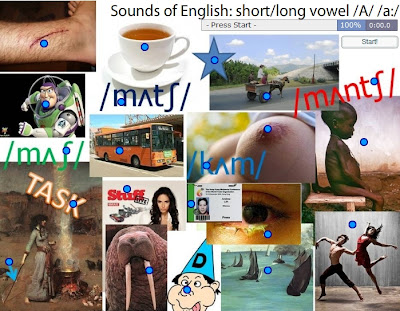
Here is the next game on the sounds of English series. This is to practise the short vowel /ʌ/ and the long vowel /ɑː/.

Click on the image above to begin the game. Try as many times as necessary for you to get 100% right. This is slightly more challenging than the previous one.

If you want to see your name appear on the scoring sheet, you'll have to register before playing. Remember your nickname & password for all my other games which are hosted on Purposegames.


Look under the category English Sounds for more pronunciation activities.

Sounds of English, short vs long vowel /ʊ/ /u:/

Chiew's CLIL EFL ESL Blog: Sounds of English

More on the sounds of English. This is to practise the short vowel ʊ and the long vowel u:

Click on the image above to begin the game. Try as many times as necessary for you to get 100% right. This should be easy compared to some of the others on this ongoing series.

If you want to see your name appear on the scoring sheet, you'll have to register before playing. Remember your nickname & password for all my other games which are hosted on Purposegames.

Either way, please leave a comment, stating your score (percentage and time).

You may also like these:

Short vs Long Vowel I and i:
Rhyming Slang Game
Rhyming Words Game
Pronunciation of Regular Past Simple
Cockney Rhyming Slang

Look under the category English Sounds for more pronunciation activities.

Friday, 15 October 2010

Sounds of English, short vs long vowel /ɪ/ /i:/

Chiew's CLIL EFL ESL Blog: Sounds of English

Continuing the series on the sounds of English activities, here's yet another one. This is to practise the short vowel ɪ and the long vowel i:

It's a very important difference, and learning it well may save you from future embarrassments. See The Man Went To Malta.

Click on the image above to begin the game. Try as many times as necessary for you to get 100% right.

If you want to see your name appear on the scoring sheet, you'll have to register before playing. Remember your nickname & password for all my other games which are hosted on Purposegames.

Either way, please leave a comment, stating your score (percentage and time).

You may also like these:

Rhyming Slang Game
Rhyming Words Game
Pronunciation of Regular Past Simple
Cockney Rhyming Slang

Look under the category English Sounds for more pronunciation activities.

Thursday, 14 October 2010

Cockney Rhyming Slang Game

Chiew's CLIL EFL ESL Blog: Cockney rhyming slang

Yesterday, I published a rhyming word game. Continuing the series on sounds of English activities, I've created a trickier one. This is more suited for higher level students. The clues are expressions of Cockney Rhyming Slang. I'd recommend your reading my post on Cockney slang first before attempting this game. For each clue, you'll have to select the image whose word is represented by the rhyming slang.

Click on the image to begin the game. Just like the other rhyming game, some of the images may not be plain obvious, so you might need a few attempts.

If you want to see your name appear on the scoring sheet, you'll have to register before playing. Remember your nickname & password for all my other games which are hosted on Purposegames.

Either way, please leave a comment, stating your score (percentage and time).

You may also like these:

Pronunciation of Regular Past Simple
Cockney Rhyming Slang

Look under the category English Sounds for more pronunciation activities.

Wednesday, 13 October 2010

Rhyming Words Game

Chiew's CLIL EFL ESL Blog: Rhyming Words

Click on the image to begin the game. You'll have to find the image whose word rhymes with the clues. Some of the images may not be plain obvious, so you might need a few attempts. I'll give a hint for one of them: it's not a bucket!

If you want to see your name appear on the scoring sheet, you'll have to register before playing. Remember your nickname & password for all my other games which are hosted on Purposegames.

Either way, please leave a comment, stating your score (percentage and time).

You may also like these:

Pronunciation of Regular Past Simple
Cockney Rhyming Slang

Look under the category English Sounds for more pronunciation activities.

Saturday, 10 October 2009

Pronunciation of regular past simple verbs /id/, /d/ and /t/ (Elementary +) Fun activity!

Most learners of English have problems pronouncing past tenses correctly. Fortunately, there are only three different ways of pronouncing the ending of regular verbs, which can be expressed by the phonetic symbols of /id/, /d/ and /t/.

Even more fortunately is that of the three, the sound of /id/ is the most obvious, and also the easiest to identify. The past simple of regular verbs ending with the sound of /d/ or /t/ is pronounced with the ending of /id/. Please note that it's the sound and not the letter which you have to pay attention to. For example, depend /dɪˈpend/ --> depended /dɪˈpendid/, want /wɒnt/ --> wanted /'wɒntid/.

If in doubt of the ending sound, consult the dictionary.

To identify when to pronounce the past with a /d/ or a /t/ is somewhat trickier. The rule is that if the ending sound is voiced, it is pronounced with a /d/ and if it is voiceless, it is pronounced with a /t/.

All vowels are voiced, so you 'only' have to worry about the consonants. When you make a voiced sound, your throat vibrates whereas when you make a voiceless sound, it is just air coming out of your mouth. You can hear the difference by trying this test: cover your ears and say 'save' /seɪv/ and 'cough' /kɒf/. You will find that you can feel a vibration at the end of 'save' and not 'cough', which means 'saved' will be pronounced /seɪvd/, while 'cough' will be pronounced /kɒft/.

Try practising the pronunciation of some words using the method mentioned above before attempting this game. The idea is to drag-and-drop each item in the correct bin as fast as you can. If your answer is wrong, you won't be allowed to put the word in that bin, and you'll have to try again.

Have fun!

Note to teachers: you are welcome to use any of the activities found here in this blog. You can have the students do them in the computer lab, or set them as homework and asking them to state their scores in the comments section. If you do the latter, please ask your students to give some information which will allow you to identify them. They don't have to give their surname if they don't want to, but information like their first name, the name of the school, the class, and the teacher's name are all useful identifiers, e.g. Jesús V./4ºA/Rincón/Chiew.

Sunday, 13 September 2009

Cockney Rhyming Slang, Game for a Steffi? Time for a Bubble? (Includes Arcade Game)

This was first published on 7th Aug.
I remember how, as a little boy, I used to devour all the books I could get my hands on, so it was hardly suprising that I developed a love for words. As a young lad, I succumbed to youth arrogance and thought myself as a better-than-average poet. Then, much later on, when I had the fortune to be hanging around with some Cockneys, I became fascinated with their rhyming slang. I didn't have a clue as to what they were saying most of the time, but it didn't matter - it sounded great! LoL

So, who or what are Cockneys and rhyming slang?

Cockneys, traditionally, refer to people born and raised in the East End of London, especially if they are of the working class, but these days you'll probably find more Cockneys out of London than you do within!

Rhyming slang refers to the way the Cockneys speak whereby they replace a normal word with another word or phrase which rhymes with it, e.g. they may say plates of meat to refer to their feet.

Sometimes, there's some kind of connection, however remote or bizarre, between the word and the slang. In the above example, I don't really see the connection (unless they were thinking of plates of bad meat and sweaty feet), but 'Spanish waiter' which is the slang for 'see 'ya later' might have stemmed from the frequency with which the Spanish waiters say 'Hasta luego!'

The other complication is, just like how we so often use only part of common idioms in our daily speech instead of the full expression (e.g. Well, I did warn you about a stitch in time...), so the Cockneys often drop part of the slang, and what's worse, they tend to drop the part that rhymes!

'Cor! Don't my plates 'alf hurt!' Imagine trying to decipher that!
Or 'All right then, I'll have just a couple of Holies with a little talk'. What??? Right. Hint: Holy ghost: toast; Talk and mutter: butter

A lot of rhyming slang is very traditional, but just as the English language evolves, so does the Cockney slang. This, of course, makes it extremely difficult to learn it if you aren't embedded in their culture.

Examples of new slang:
Barack Obama: charmer (I tell you, mate, all them girls think he's a right ol' Barack.)
Jenson Button: mutton as in mutton dressed as lamb (Yikes, she's such a Jenson!)

Of course, just like new English words, some may survive while others simply fade away. Whether it makes it easier is debatable, but most of the new slang tend to rhyme with names of famous personalities with a few exceptions, such as wind and kite (web site).

So, are you all ready now to learn some rhyming slang and have some bubbles (bubble bath: laugh)? It's easy - all you need to do is to look for the word that rhymes! Have fun learning!

If you like this game, please link to it by copying and pasting this HTML code (click anywhere inside the box, click ctrl+A, then ctrl+C) into your own blog or web template. This is the badge you'll get:

Games for Education

Sunday, 30 August 2009

Crossword - Phonetics 3 (Intermediate Plus)

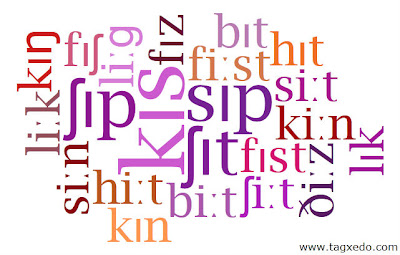
Test your phonetic knowledge. This is suitable for intermediate upwards. Answers will be available in the next post.
Have fun learning!

Phonetics 3

Thursday, 27 August 2009

Crossword - Phonetics 2 (Intermediate Plus)

Test your phonetic knowledge. This is suitable for intermediate upwards. Answers will be available in the next post.
Have fun learning!

Phonetics 2