Showing posts with label animals. Show all posts

Thursday, 29 September 2011

Truth or Lie: Activity for any classroom

Chiew on iasku Blog Challenge truth or lie

I recently responded to a blog challenge by a video recording of myself - you can see it by clicking here. Most EFL teachers are probably aware of the activity where students are asked to say some things about themselves, and the others are to guess if they're true or false.

I suggested taking this a step further and have the students bring video recordings of themselves saying those things.

But, you can take it yet another step further. Although this activity is popular in the EFL classroom, there's no reason why it can't be used in the other classes, too. The topic doesn't need to be personal; it could be on anything. Examples:
  • What is a tangent, or an apex? (Geometry/Art)
  • They could describe an animal or an ecosystem. (Science)
  • They could talk about the rules of rugby. (PE)
  • They could talk about countries, or climate. (Geography)
As you can see, the limit is the extent of your imagination! Try it and let us know!

Monday, 31 January 2011

Idioms Part 13 (Animals Turkey - Worms) Interactive Game

In a Pickle: And Other Funny Idioms   Scholastic Dictionary Of Idioms (Revised)   Webster's New World American Idioms Handbook


Chiew's CLIL EFL ESL ELL TEFL Free Online Games Activities: Animal Idioms

Click on the image to begin the game. Match the meanings of the idioms to the dots on their left, and match the vocabulary to the images.

Note that for your scores to be recorded, you would need to register (it's free, no strings attached, no spam) at Purpose Games, where the game is hosted.

These are the idioms tested in this game:

talk turkey

We say we're talking turkey when we're discussing something seriously.

on a wing and a prayer

To do something on a wing and a prayer is to do something with only the slightest hope of succeeding, often in a desperate situation. This expression actually came from a WWII patriotic song which went something like this:

Comin’ in on a wing and a prayer
What a show, what a fight, boys
We really hit our target for tonight
How we sing as we limp through the air
Look below, there’s our field over there
Though there’s one motor gone
We can still carry on
Comin’ in on a wing and a prayer.

This expression is often used wrongly with wing being substituted by whim or wink: on a whim and a prayer.

in the wings

The wings in a theatre are the left and right side of the stage where, unseen by the audience, performers wait for their turn to get on stage. So, when someone's in the wings, it means that they are ready to be called upon to do something when needed.

While we're on the subject of wings, you may also have heard the expression "wing it". This means to do something without proper preparation:

During my speech at the conference yesterday, the computer suddenly broke down, so I had to wing it without my PowerPoint presentation.

keep the wolf from the door

If you keep the wolf from the door, you manage to ward off poverty or hunger.

throw to the wolves

When you throw someone to the wolves, you send them to a terrible fate. You put them in a situation where you don't protect them, and where they are attacked or criticized.

You can also be thrown/tossed/fed to the lions, or to the dogs.

the worm turns

This comes from an old proverb, 'Tread on a worm and it will turn'. This means that someone who has been treated badly for a long time decides that he will no longer accept the provocation and starts defending himself.

It is often used as 'even the worm will turn'.

a can of worms

This is often used with 'open' as in, 'Oops, you've just opened a can of worms!'

Cans of worms used to be sold as fishing bait (I'm not sure if they still are). Imagine opening one. Yuck! All those wriggly things creeping out, and it's just impossible to close the lid on them again!
Well, it's like that. When you open a can of worms, you release a host of problems or complications, often quite controversial.

Be sure to check out the rest in this series:

Saturday, 29 January 2011

Idioms Part 12 (Animals Rats-Tails) Interactive Game

In a Pickle: And Other Funny Idioms   Scholastic Dictionary Of Idioms (Revised)   Webster's New World American Idioms Handbook

This time, I feel generous, and I'll explain the meaning of the idioms first. If you think you know them, you can skip the explanation and go straight to the game.

Match the meanings of the idioms to the dots on the left, and match the vocabulary to the images.

Note that for your scores to be recorded, you would need to register (it's free, no strings attached, no spam) at Purpose Games, where the game is hosted.


Chiew's CLIL EFL ESL ELL TEFL Free Online Games Activities: Animal Idioms


smell a rat

Dogs used to be used to hunt and destroy rats probably because of their strong sense of smell. Hence this expression is used when one senses that something is not quite right.


separate the sheep from the goats

This expression comes from the Bible. Sheep were potrayed as gentle creatures while goats were unruly, so we use this idiom to express the idea of separating something positive from something negative, e.g. the clever from those who aren't.


a wolf in sheep's clothing

This phrase appeared both in Aesop's Fables and the Bible and is used to speak of someone who pretends to be good or friendly, when he is actually the opposite.


a snake in the grass

If you see a snake in the grass, you'd be very careful, wouldn't you? We use this idiom to refer to someone we can't trust, someone who is capable of deceit.


the tail wagging the dog

When someone diverts attention from something important to something less important, we can say he's wagging the dog.

It is also used to say that a situation is crazy because something less important is controlling something which is far more important.


with your tail between your legs

When a dog is defeated by a stronger dog, it backs away with its tail between its legs; so, this idiom is used to denote that you feel ashamed because you have been defeated.

Be sure to check out the rest in this series:

Part 1 (Transport)
Part 2 (Animals Ants - Birds)
Part 3 (Animals Bees - Cats)
Part 4 (Animals Dogs)
Part 5 (Animals Elephant - Flea)
Part 6 (Animals Fly - Hawk)
Part 7 (Animals - Horses)
Part 8 (Animals - Horses Part 2)
Part 9 (Animals Kittens - Lions)
Part 10 (Animals Monkeys - Pigs)
Part 11 (Animals Pigeons - Rats)

Wednesday, 26 January 2011

Idioms Part 11 (Animals Pigeons - Rats) Interactive Game

In a Pickle: And Other Funny Idioms   Scholastic Dictionary Of Idioms (Revised)   Webster's New World American Idioms Handbook

As usual, check the exact meaning of the idioms if you aren't sure as, sometimes, I have to condense the clue for it to fit in the box.

Match the meanings of the idioms to the dots on the left, and match the vocabulary to the images.

Note that for your scores to be recorded, you would need to register (it's free, no strings attached, no spam) at Purpose Games, where the game is hosted.

Chiew's CLIL EFL ESL ELL TEFL Free Online Games Activities: Animal Idioms

Be sure to check out the rest in this series:

Part 1 (Transport)
Part 2 (Animals Ants - Birds)
Part 3 (Animals Bees - Cats)
Part 4 (Animals Dogs)
Part 5 (Animals Elephant - Flea)
Part 6 (Animals Fly - Hawk)
Part 7 (Animals - Horses)
Part 8 (Animals - Horses Part 2)
Part 9 (Animals Kittens - Lions)
Part 10 (Animals Monkeys - Pigs)
Part 11 (Animals Pigeons - Rats)

Thursday, 20 January 2011

Idioms Part 9 (Animals Kittens - Lions) Interactive Game

Essential Idioms in English: Phrasal Verbs and CollocationsThis game, Part 9 of this series, has a mix of idioms, meanings of idioms, and images of animals.

The first three sentences are the meanings of idioms. Match the idioms in the clue box to these.

The last three are idioms with the missing animal. Match their meaning to the dot on the gaps, and match the animal to the images.

Even if you don't understand my explanation, a few seconds into the game will make it all perfectly clear!  ;-)

Chiew's CLIL EFL ESL ELL TEFL Free Online Games Activities: Animal Idioms


Be sure to check out the rest in this series:

Part 1 (Transport)
Part 2 (Animals Ants - Birds)
Part 3 (Animals Bees - Cats)
Part 4 (Animals Dogs)
Part 5 (Animals Elephant - Flea)
Part 6 (Animals Fly - Hawk)
Part 7 (Animals - Horses)
Part 8 (Animals - Horses Part 2)
Part 9 (Animals Kittens - Lions)
Part 10 (Animals Monkeys - Pigs)
Part 11 (Animals Pigeons - Rats)

Tuesday, 18 January 2011

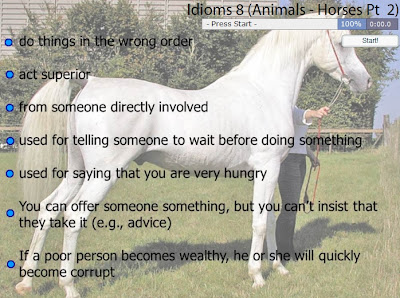
Idioms Part 8 (Animals - Horses Part 2) Interactive Game

The American Heritage Dictionary of Idioms
As in Part 7, this one is on horses, too, and the idioms are given as the clues. Unfortunately, a couple of them are long ones, so you will see only a part of them. However, being so kind, I'm listing the full idioms below ;-)


put the cart before the horse
get on your high horse
hold your horses
from the horse's mouth
I could eat a horse
You can lead a horse to water, but you can't make it drink
Set a beggar on horseback, and he’ll ride to the devil

Chiew's CLIL EFL ESL ELL TEFL Free Online Games Activities: Animal Idioms


Be sure to check out the rest in this series:

Part 1 (Transport)
Part 2 (Animals Ants - Birds)
Part 3 (Animals Bees - Cats)
Part 4 (Animals Dogs)
Part 5 (Animals Elephant - Flea)
Part 6 (Animals Fly - Hawk)
Part 7 (Animals - Horses)
Part 8 (Animals - Horses Part 2)
Part 9 (Animals Kittens - Lions)
Part 10 (Animals Monkeys - Pigs)
Part 11 (Animals Pigeons - Rats)

Monday, 17 January 2011

Idioms Part 7 (Animals - Horses) Interactive Game

Webster's New World American Idioms HandbookHere's part 7 of this series on idioms. This time, the meanings are given, and you have to match the idioms to them. As I've mentioned several times before, the clue box allows a maximum of 34 characters (I think), so I have to adapt to this restriction one way or another. For this game, however, I decided to let the idioms simply truncate, so it's only fair to show you the full idioms first:


Beat/Flog a dead horse
Change horses in midstream
Wild horses couldn't/wouldn't drag someone somewhere or Wild horses couldn't/wouldn't  make someone do something
If wishes were horses then beggars would ride
If two ride on a horse, one must ride behind
To look a gift horse in the mouth

Chiew's CLIL EFL ESL ELL TEFL Free Online Games Activities: Animal Idioms


Be sure to check out the rest in this series:

Part 1 (Transport)
Part 2 (Animals Ants - Birds)
Part 3 (Animals Bees - Cats)
Part 4 (Animals Dogs)
Part 5 (Animals Elephant - Flea)
Part 6 (Animals Fly - Hawk)
Part 7 (Animals - Horses)
Part 8 (Animals - Horses Part 2)
Part 9 (Animals Kittens - Lions)
Part 10 (Animals Monkeys - Pigs)
Part 11 (Animals Pigeons - Rats)

Sunday, 16 January 2011

Idioms Part 6 (Animals: Fly - Hawk) Interactive Game

In a Pickle: And Other Funny IdiomsThe sixth in this series of games on idioms. Please appreciate that I have to keep the clues short due to space restriction. Feedback appreciated!

Chiew's CLIL EFL ESL ELL TEFL Free Online Games Activities: Animal Idioms


Be sure to check out the rest in this series:

Part 1 (Transport)
Part 2 (Animals Ants - Birds)
Part 3 (Animals Bees - Cats)
Part 4 (Animals Dogs)
Part 5 (Animals Elephant - Flea)
Part 6 (Animals Fly - Hawk)
Part 7 (Animals - Horses)
Part 8 (Animals - Horses Part 2)
Part 9 (Animals Kittens - Lions)
Part 10 (Animals Monkeys - Pigs)
Part 11 (Animals Pigeons - Rats)

Idioms Part 5 (Animals - Elephant - Flea) Interactive Game

Scholastic Dictionary Of Idioms (Revised)
Perhaps some of you might have noticed that I haven't included the meanings of the idioms, but rather, go straight into the game stage. I think it's a better way of learning, and since I haven't heard any complaints so far, I'm carrying on the same path.


Please note that, in any case, you are advised to look up the full meaning of the idioms as I'm restricted in the number of words I can put in the clue box.

Chiew's CLIL EFL ESL ELL TEFL Free Online Games Activities: Animal Idioms

Be sure to check out the rest in this series:

Part 1 (Transport)
Part 2 (Animals Ants - Birds)
Part 3 (Animals Bees - Cats)
Part 4 (Animals Dogs)
Part 5 (Animals Elephant - Flea)
Part 6 (Animals Fly - Hawk)
Part 7 (Animals - Horses)
Part 8 (Animals - Horses Part 2)
Part 9 (Animals Kittens - Lions)
Part 10 (Animals Monkeys - Pigs)
Part 11 (Animals Pigeons - Rats)

Saturday, 15 January 2011

Friday, 14 January 2011

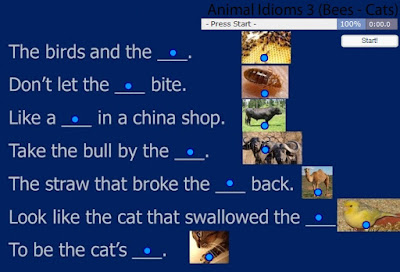
Idioms Part 3 (Animals Bees - Cats) Interactive Game

There's been a slight change to the format of these games on idioms following a suggestion by "afasico". In order not to make the games too easy, I'd replaced the missing words with images, although I was in two minds about it. This is why I value feedback immensely.

As "afasico" quite rightly pointed out, you can't normally replace key words in idioms. For example, we say 'like the back end of a bus', but someone used to US English might have used 'coach' to replace the image of the bus, and 'like the back end of a coach' just doesn't sound right, does it?

So, now, the idioms have a missing word. This missing word will be represented by an image. There are two clues for each idiom. If the clue gives you the meaning of the idiom, you will have to match it to the gap in the idiom. If the clue is the missing word, e.g., 'bus', you'll have to match it to the image.

Chiew's CLIL EFL ESL ELL TEFL Free Online Games Activities: Animal Idioms

Be sure to check out the rest in this series:


Part 1 (Transport)
Part 2 (Animals Ants - Birds)
Part 3 (Animals Bees - Cats)
Part 4 (Animals Dogs)
Part 5 (Animals Elephant - Flea)
Part 6 (Animals Fly - Hawk)
Part 7 (Animals - Horses)
Part 8 (Animals - Horses Part 2)
Part 9 (Animals Kittens - Lions)
Part 10 (Animals Monkeys - Pigs)
Part 11 (Animals Pigeons - Rats)

Wednesday, 5 January 2011

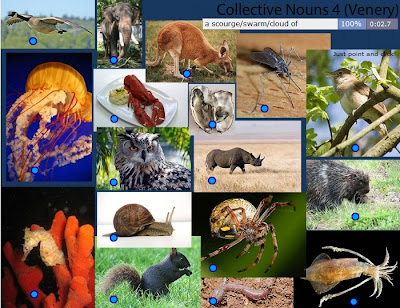
What do you call a group of...? (Games on animals and collective nouns)

Though 'a group of ladies' or 'a group of dogs', are both grammatically correct, 'group' is rather mundane, and often used when we don't know the collective noun for the object we're referring to. A collective noun is the word we use to refer to a group of things such as people or animals. Words referring to groups of animals are also known as terms of venery, e.g., a pride of lions, a pack of wolves.

Having said that, however, some collective nouns are not commonly used, and are considered fanciful or humorous terms, e.g., a blush of boys or a pity of prisoners, and some words can have more than one valid collective noun, e.g., a cohort/herd/zeal of zebra. Similarly, the same collective noun may be used for different objects, such as a flock of seagulls/sheep/camels/pigeons/etc..

I've created a few games here. The elementary learners can do the animal identification game quite comfortably, and if they are adventurous enough, they can try the others, too.

Identify these animals Part 1

Chiew's EFL ESL ELL CLIL Games Activities Juegos Actividades: What is the collective noun for

Identify these animals Part 2

Chiew's EFL ESL ELL CLIL Games Activities Juegos Actividades: What is the collective noun for

What are the collective nouns for these animals Part 1?

Chiew's EFL ESL ELL CLIL Games Activities Juegos Actividades: What is the collective noun for

What are the collective nouns for these animals Part 2?

Chiew's EFL ESL ELL CLIL Games Activities Juegos Actividades: What is the collective noun for

Chiew's EFL ESL ELL CLIL Games Activities Juegos Actividades: What is the collective noun for