When Sir Ken Robinson speaks, one usually listens. He's a wonderful storyteller, a great speaker. He has no need for notes, merely relying on his memory, his experience, his passion. And, he's funny. Talking about passion is his passion. Recently, in March, to be exact, he spoke in Conway Hall, London; he spoke about finding our purpose in life. So, when I found out that Vimeo has published a video of his sermon, I rushed straight in. As usual, he spoke with his typical wit, recounting story after story. Even though it's 50 minutes, I can assure it'll be well spent.

Showing posts with label funny videos. Show all posts
Showing posts with label funny videos. Show all posts
Friday, 17 June 2011

Monday, 6 June 2011
Wagging the question, tagging the dog
You can tag the dog, but can you wag the question? Watch these two hilarious videos, and my question may become a little clearer. Reading Idioms Part 12 may also help.
UK version:
US version:
The main issue, as you've probably noticed, is that of question tags (in both versions). In the US version, one of the girls constantly mixes up idioms - this is difficult to understand if you don't know the idioms to begin with!
Either or both of these videos can be used with intermediate level upwards (even up to non-native teacher level) - you know your students, you judge. What I'd normally do is to play the video once. Hand out the script. Play the video again. Then, ask them to find and correct the mistakes. Check and explain. Later, discuss the making and correction of mistakes. Are they afraid/embarrassed to make mistakes? Do they feel people might laugh at them? Do they like being corrected by their teachers/peers? What are their most common errors? Why do they keep making them even though they realise it? Elicit methods from the class of 'tricks' they use to help them remember.
A quick explanation on question tags
We add these at the end of sentences to confirm what we are saying; it's like saying, 'Do you agree?' or 'Don't you think so?'. They're the equivalent of, for example, n'est-ce pas? in French and verdad? in Spanish.
The tag comprises of an auxiliary verb (or the verb 'be') and a pronoun:
We've met before, haven't we?
She's really gorgeous, isn't she?
Usually, a positive tag follows a negative sentence, and a negative tag follows a positive sentence:
You don't know where I can find a locksmith, do you?
You were supposed to be here at five o'clock, weren't you?
Notice that the tag agrees with the verb in the preceding sentence:
She won't do it, will she? (modal auxiliary 'will')
They were singing really well, weren't they? (past continuous with the past form of 'be' as a tag)
The verb 'have' sometimes causes confusion. As you may know, the British usually use 'have got' to talk about possession:
Janet's got a really stunning voice.
We can only use the verb 'have' as a tag in this case.
Janet's got a really stunning voice, hasn't she?
However, if we use 'have' as the main verb, both 'have' and 'do' are acceptable as tags:
Janet has a really stunning voice, hasn't she?
Janet has a really stunning voice, doesn't she?
Note the tag we usually use with 'I am':
I'm clever, aren't I?
Or you may hear
I'm clever, ain't I? (non-standard)
SCRIPT (UK VERSION)
Hi! Are we all on the same English course?
Oh yeah, how's it going?
Not bad, but sometimes I have trouble with grammar, isn't it?
Really?
Sometimes I spot on and other times I don't, aren't they?
I'm all right with my grammar; my problem is spilling.
Can't spill to save my loaf!
I have to rely on my spill chock on my compluter!
Well, don't worry about it too much.
I'm sure you'll be treated with a lot of understanding and COMPASSION!
All right!
I've got problems with my spilling not my herring!
She's got trouble with her punctuation, isn't it?
Yeah, sorry.
I sometimes put an explanation mark at the end by MISTAKE!
It's all right for you lot; I've got a very small vocabulary.
What's that like?
It's all right for you lot; I've got a very small vocabulary.
Sometimes I have trouble with my emphaasis.
Your emphaasis?
Yes. In variious different parts of my senteences.
In my job that can cause a lot of awkwordness.
What do you do?
I'm a speech theraapist.
A speech therapist who can't spike prifferly!
I'm surprised your boss hasn't sucked you!
It's all right for you lot; I've got a very small vocabulary.
Can I make a suurgestion?
Why don't you purchaase a dictionary? You'll save yourself a lot of embarraasment.
I know! We could all try studying together, isn't it?
How doesn't next week sounds?
GOOD IDEA!
It's all right for you lot...
SHUT UP!
SCRIPT (US VERSION)
Hey! Aren't we all on the same English course?
Oh yeah, how's it going?
Er, not bad, except that I sometimes have trouble with my grammar, isn't it?
I mean sometimes I perfect but other times I don't, won't they?
You see, I'm all right with my grammar; my problem is spelling.
I can't spell to save my loaf!
Yeah?
Yeah, I have to rely on my spell chock on my compluter!
Well, you know, look at it this way. You can lead a horse to water, but you can't eat it, too. You know what I'm saying?
No, no, not really.
Er...I think that she sometimes has trouble mixing metaphors, aren't she?
Yeah.
Sorry, guys. I'm always crying over spilt chickens before they're hatched.
It's all right for you all; I've got a very small vocabulary.
What's that like?
It's all right for you all; I've got a very small vocabulary.
That's ok. I have problems with my emphaasis.
Your emphaasis?
Yes. My emphaasis. On different parts of the sentances.
In my job that can cause a lot of awkwordness.
What do you do?
I'm a speech theraapist.
A peach therapist that can't spike prifferly!
I'm surprised your boss hasn't sucked you!
It's all right for you all; I've got a very small vocabulary.
Can I make a suurgestion?
Why don't you purchaase a dictionery? You'll save yourself a lot of embarraasment.
I'll tell you what. Why doesn't we all try studying together, isn't it?
How does next week sound, didn't we?
Brave idea!
Fabuulous!
Yeah, You give 'em an inch, it's worth two in the bush.
It's all right for you all...
SHUT UP! Isn't it?
The correct idioms are:
You can give someone the opportunity, but you can't force him to take it.
To want to have two things which are incompatible.
It's no good/use crying over spilt milk or There's no point crying over spilt milk:
It's no use getting upset over something that had happened but that cannot be undone.
Count one's chickens before they hatch:
To imagine what you'd do with the results of something that hasn't been accomplished yet.
give someone an inch (and they’ll take a mile/yard):
This refers to people who wants more and more of what is given to them.
a bird in the hand (is worth two in the bush):
What you definitely have is far better than something which, although it could be better, is not guaranteed.
Related posts:
Saturday, 5 March 2011
What's your English? Do you often have a chinwag about her ba-donka-donk?
Much has been said about the differences between American and British English, so much so that any EFL course, from Andorra to Auckland, will dedicate at least one lesson to this topic. One can be forgiven to think that these are the only two significant versions that exist. Of course, we know that this is not true, and besides, what is British English? Someone from Dorset doesn't quite speak like someone from Aberdeen, or Swansea, and I'm not just talking about accents.
All versions of English are valid, and the more variety that one is exposed to, the better it is. There is a trend in countries where English is not widely spoken to insist on "native" teachers for an EFL post, and this is rather unfair to the "non-native" teachers. As a lot of them will attest, "native" teachers aren't necessarily better than them.
MacMillan's 'What's your English?' campaign is, therefore, to be applauded. Do try to read some of their articles on other "Englishes": Macmillan's International English
They also recently teamed up with Professor Elemental to produce the hilarious Canadian vs British English rap battle. You can watch it below, and also download the script (you'll probably need it!) from here. If you haven't heard of the eccentric Professor Elemental (real name: Paul Alborough), check out his site: http://www.professorelemental.com
You can also watch the US vs UK English challenge with Hugh Laurie and Ellen DeGeneres after Professor Elemental's. It's quite funny, too.
So, what's your English? Are you a "non-native" teacher teaching English in your own or a foreign country? Whether you are one or otherwise, I would love to hear your opinions. If you're a student, your opinions would be most treasured, too.


Friday, 4 February 2011
The Fun Theory
Some of you might have noticed that the motto of this blog, as seen on the header, is 'Putting the Fun into Education!", but little did I know of Volkswagen's initiative, The Fun Theory, expounding "the thought that something as simple as fun is the easiest way to change people’s behaviour for the better. Be it for yourself, for the environment, or for something entirely different, the only thing that matters is that it’s change for the better".
So, I wasn't the only one who believed that fun is the key to changing people's perception of what they might consider boring. Perhaps VW had read my blog... haha. Anyway, they had the resources to go out and prove it in some really interesting ways! Watch these videos.
Friday, 19 November 2010
More on Jobs: Video singalong & Games
Here are more fun activities on jobs! The song, People In My Town, is by Peter Weatherall , and he's got some great stuff. A CD of his in your department wouldn't go amiss, really.
Be sure to take a look at these older activities, too:
Online Crossword
Jack of all Trades

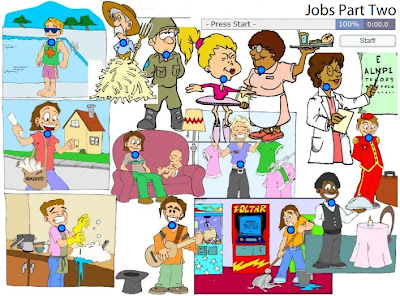

, and he's got some great stuff. A CD of his in your department wouldn't go amiss, really.Be sure to take a look at these older activities, too:
Online Crossword
Jack of all Trades
Thursday, 24 June 2010
Does education kill creativity?
If you're an educator, you must watch this video! If you're a student, watch and see if you agree with the speaker. Subtitles are available in several languages, but I'd suggest you try English first.
Now that the school year has ended, you can spare these few minutes to listen to what Sir Ken Robinson has to say. And, he's so hilarious! To be a good public speaker is a great talent, but to be a funny one is even more admirable.
Those who have heard Sir Ken before know that he's rather wonderful with quotes, and here he makes no exceptions, and uses Yeats' Cloths of Heavens (1899) and Abraham Lincoln's message to congress just one month before signing the Emancipation Proclamation (1862) to great effect.
"Had I the heavens' embroidered cloths,
Enwrought with golden and silver light,
The blue and the dim and the dark cloths
Of night and light and the half light,
I would spread the cloths under your feet:
But I, being poor, have only my dreams;
I have spread my dreams under your feet;
Tread softly because you tread on my dreams."
- William Butler Yeats (The Wind Among the Reeds 1899)
"The dogmas of the quiet past, are inadequate to the stormy present. The occasion is piled high with difficulty, and we must rise -- with the occasion. As our case is new, so we must think anew, and act anew. We must disentrall ourselves, and then we shall save our country."
- Abraham Lincoln's Annual Message to Congress -- Concluding Remarks, 1862
Now, after watching that, you must be curious about his other talk, so here it is, the one he gave in 2006:
So, what are your opinions? Is Sir Ken right? Is education too academically orientated? Are we stifling creativity in our children? Your opinions, as usual, will be most appreciated.
Wednesday, 9 June 2010
Should more technology be used in the classroom?
UPDATED: 13 June 2010 to include a new video.
Original post by Sue Lyon-Jones can be seen here.
This video is especially dedicated to those from 'the old school' who stubbornly hold firm to their paper-bonded ideas, but since they would be the last people to come here, I would like to hear the opinions of the students themselves!
What do you think?
Should more technology be used in the classroom?
How? In which subjects?
How often are you brought to the computer lab? Which subjects?
Does technology help you learn better?
What is the most interesting subject? Why?
What is the least interesting? Why?
What do you think?
Should more technology be used in the classroom?
How? In which subjects?
How often are you brought to the computer lab? Which subjects?
Does technology help you learn better?
What is the most interesting subject? Why?
What is the least interesting? Why?
All comments are welcomed! If you aren't confident of writing in English, you can write in your native language. I don't mind!
Thank you!

They tried to make me teach with Edtech,
I said No! No! No!
Yes I'm old hat, don't care about that,
I don't want to know,
I ain't got the time,
And if the students think I'm fine,
They tried to make me teach with Edtech,
I don't want to know!
I ought to be at home, marking essays,
My week has only got seven days!
And there's nothing, nothing you can teach me,
That I can't learn from Mr Thornbury!
Don't need no edtech in my class,
It's such a load of faff - no thanks! I'll pass...
They tried to make me teach with Edtech,
I said No! No! No!
Yes I'm old hat, don't care about that,
I don't want to know,
I ain't got the time,
And if the students think I'm fine,
They tried to make me teach with Edtech,
I don't want to know!
Alexandra Francisco just made this one, so I though I'd add it.
Sunday, 20 September 2009
Ideas for using videos in the classroom
As teachers, we have to be innovative, to keep up with the times, so to speak. The days of teaching with a book, chalk and blackboard are long gone now. Every year, more and more schools are installing digital boards, more classes are having projectors and white boards, if not a screen, and it won't be long before every class will be equipped with a complete audiovisual system, computer included; and, we might even get to see, in the not too distant future, a computer on every desk.
Those who know me are aware that I am an advocate for the use of IT in the classroom, as I strongly believe that most children love the dynamism of sound and image and it's a far more effective way of capturing their attention than the traditional board; and those who have been following this blog would have seen many activities which have been designed to be used interactively, and would have read about the different ideas for practising the skills involved in learning a language. Hopefully, they have been of some use.
In this post, I'll try to put across some ideas on how to make the most of using videos in the class. Students, both young and old, love watching images fluttering on the screen, but we'd need to tap into that. Showing a movie for the duration of the class, or even two classes, while you sit and mark your exams, or prepare for the next lesson, is not taking advantage of the potential of video teaching.
Even though I write with teaching English in mind, the same ideas can be used for teaching other subjects. Don't show the whole film, unless it's a very short one. Generally, showing 5-15 min segments are more useful.
You can use films, trailers, extras found in dvds, youtube or teachertube videos, music clips, etc. By all means, show subtitles, but only English, never with their native language subtitles because they will be reading and not listening, while with English subtitles, they will be both listening and reading.
Encourage students and parents to watch films in the original language, preferably with English subtitles rather than with their native language. In fact, every few months, you can assign a film to be watched at home, or you can have a selection, and let the students swap them among each other.
They then talk about it in class, and can also be requested to submit a written report such as a review or a discussion question set by you, for example.
For class viewing, choose a segment which is appropriate to the level of your students.
Here is a selection of activities you can use:
Turn volume and subtitles off. Show a short segment. Ask students to imagine what the actors are saying. Ask them to imagine the situation before and after. Even if they have seen the video before, it doesn't matter. The main objective is for them to speak. You can also do this activity in groups or have different groups where some work on the situation before the scene while others work on what happens after the scene. Then they get together and each group tells the class its version.
Alternatively, don't show the video, but instead, let them listen first. Based on this, they imagine the setting, the characters (maybe they can guess the actors), etc. Depending on the segment you have chosen, you may be able to get them to do the previous exercise, too (imagining the situations before and after the scene). Tell them to listen not only to the dialogue, but also to the noises (crashes, gunshots, howling wind, etc) and the soundtrack. Listen to the silence, too, if any, as silence can work wonders on the imagination. All these may give important clues to the nature of the scene.
Have activities for different stages. For example, before watching: discussion questions and vocabulary activities; while watching: listening exercises such as gap filling; after watching: discussion questions.
Discussions need not be restricted to the film's content only. For example, the wedding scene in The Godfather can be used as a springboard for a discussion on wedding celebrations of different cultures; or any film can be used to start a conversation on cinema etiquettes, introducing or revising language such as 'Do you mind...' 'Could you please...', 'fancy', 'care for', and 'Would you like...' See also my post on Invitation to the cinema.
Next time you watch a film, program your chip to teacher mode. Watch out for scenes you could make the most of in listening activities. Examples are dialogue situations we often use in class such as airport announcements, checking into a hotel, restaurant scenes, etc.
As for vocabulary, don't restrict yourself to the same techniques. Vary them. There are many ways of learning vocabulary such as scrabble, crosswords, jumbled characters, mind maps, gapfill, etc. I'll do an 'Ideas for vocabulary activity' article some time in the future, so make sure you've subscribed here!
If the film has been adapted from a book, you can ask students to read the book first (or the part which you will be showing). Then, show the segment. Discuss the differences (in dialogue, settings, characters, etc) between the book and the film.
Alternatively, have them read the film script (or role-play it). Ask if they know the title of the film, the cast, the scene, etc.
If you like Wordle as I do, create one with part of the script and see if they can guess where it comes from. Discuss as above.
 |
| From a cLiL to cLiMB |
Google the Internet for websites specialising in film scripts. Here are a few links:
Recipes are very useful for teaching imperatives, sequence words, and food & kitchen vocabulary. Videojug has a wonderful collection of recipes from all over the world, explained clearly and concisely.
If you have the dvd of Kung Fu Panda, you may have the special feature on the art of noodle making. I've used this with my students and they loved it.
If you have the dvd of Kung Fu Panda, you may have the special feature on the art of noodle making. I've used this with my students and they loved it.
Another fun movie activity is Watch and Tell. Form the students in pairs. They sit with their backs facing each other. The one facing the screen watches the film, and while watching it, he relates all he can to his partner, who, in turn, tries to write down everything his partner is telling him. After a few minutes, they swap their positions, and repeat the process. When you stop the screening, they try to piece the story together, and relate it to the class.
Try to choose a film with little or no dialogue. Something like Mr Bean or Wallace & Gromit work well. Alternatively, turn the volume off - the disadvantage here is that they can't hear the music and other noises, which are what make films exciting. If you like, you can always choose a certain grammatical aspect to concentrate on. You can ask them to write in present simple or present continuous or relate in the simple past, for example.
Special thanks go to Claudio, who has a wonderful site with grammar activities for a wide range of films. Check it out here.
For video clips, apart from dvds obviously, have a look at TeacherTube.
For lesson plans based on video clips, you light like TEFLclips.
If you have any more ideas to add to these, please share them in the comments section below.
Thanks!
Thanks!
Monday, 3 August 2009
Chinese Whispers - 5 min fillers {游戏学英语}
All teachers will be aware that it's always best to have too much prepared than too little, so it's always handy to have a stock of 5-minute fillers in your resource mind bag. One of the popular ones is Chinese Whispers, a game often played by children in parties or in the playground, where the first player whispers a phrase or sentence to the next player. Each player successively whispers what that player believes he or she heard to the next. The last player announces the statement to the entire group. The result is often hilarious due to errors being accumulated as the sentence passes from one person to the next.
Chinese whispers is actually nothing to do with the Chinese. It originates from the old (I hope) European stereotype of the Chinese language being incomprehensible. The term is now considered offensive to some people, so other terms are being used, such as Chain whispers, Telephone, Broken Telephone, Gossip, etc.
The other day, we read about how Tyler Bradt broke the world record for running waterfall. Here we see a sillier kind of record, the record for the longest chain whisper, but the whispered message is rather a novel way of doing something significant. Watch this and you'll see what I mean.
Chinese whispers is actually nothing to do with the Chinese. It originates from the old (I hope) European stereotype of the Chinese language being incomprehensible. The term is now considered offensive to some people, so other terms are being used, such as Chain whispers, Telephone, Broken Telephone, Gossip, etc.
The other day, we read about how Tyler Bradt broke the world record for running waterfall. Here we see a sillier kind of record, the record for the longest chain whisper, but the whispered message is rather a novel way of doing something significant. Watch this and you'll see what I mean.
Monday, 6 July 2009
Michael Jackson's ghost?
Watch it and believe what you want to believe! (See idiom posting on the right column)
Wednesday, 1 July 2009
Mind Your Language
I wonder how many of you have seen this comedy series popular in the 70s. Oh, it probably will never see the light of day now because almost certainly it'll be deemed politically incorrect. It still makes me laugh my head off after all these years. Now, I'm British, though not born British but rather a 'naturalised' British (strange word, that - as though I wasn't 'natural' before that!). If there's one thing I can say about the British, it's that they're a bunch of people who can laugh at themselves, and the series is really about people being able to laugh at themselves. If you enjoy it, I suggest you look for the dvds. Great teacher and great students! LoL
Monday, 22 June 2009
Sounds of English
I normally like to do at least one Sounds of English lesson with my students- phonetics need not be boring! There are some English sounds not present in a language such as Spanish, and it's always a challenge to get the students to get them right. Sound files cannot, at the moment, be uploaded to blogger (it beats me, really), so I've done it quickly as a 'video'. It's something I first heard ages ago, but when I'm down, I listen to it and it perks me up! It's not something I've used in class, so here's an opportunity for everyone to hear it here! :-)
Subscribe to:
Posts (Atom)