Sunday, 1 July 2012

Basic parts of a bicycle

It's been a long time since I created a tagging game, so it's about time I rectify that. Here's one on the basic parts of a bicycle. These are the answers. To play the game, click on the image.


  1. bell
  2. brake lever
  3. stem
  4. cable
  5. top tube
  6. brakes
  7. spoke
  8. fork
  9. valve
  10. flat tyre (puncture)
  11. front reflector
  12. down tube
  13. saddle (seat)
  14. seat post
  15. seat post clamp
  16. seat tube
  17. tyre
  18. chain
  19. crank arm
  20. pedal
  21. rear reflector
ELT CLIL EFL ESOL Bicycle parts game activity

If you need higher-resolution images, click on the following images.

ELT CLIL EFL ESOL Bicycle parts game activity
Image by C. Pang

ELT CLIL EFL ESOL Bicycle parts game activity
Image by C. Pang

Friday, 15 June 2012

A case for CPD and PLN...

ELT EFL ESL CLIL PLN CPD Resources, images, ideas
Photos by me. See more here.

Here's an example of how a seed is taken and planted with care many miles away where it soon grows into a pretty flower. This flowering stem is again taken some distance away, where it grows and grows and we now have a lush beautiful garden...

It all started with a comment I made in Scott Thornbury's post on iTDi's blog "How important is homework?" I'd first talked about it in The Dogme Diaries, but I don't suppose many people read that ;-)

I mentioned that the homework I set a class of adult teachers was basically three questions:
  • What have you learnt today?
  • What part of the lesson did you like or dislike in the class today?
  • What would you like to do in class next week?
A couple of months later, Alexandra Chistyakova wrote to say that she'd used the questions with her class of university students, and how well that had gone down. You can read about how she moulded my homework to suit her personality and that of her class here:


Then, a little while later, Barbara Bujtás read Alexandra's posts and decided to adapt it to her class of 3-year-olds! You can read about it here:


You can see the beauty of her work here:


So, if you're not involved in a PLN (personal learning network) or have not been convinced of it, I hope this little episode will serve to change your mind!

Alexandra and Barbara, you both rock!

Learn about continuing professional development here: http://www.scoop.it/t/continuing-teacher-development

Learn about the benefits of Twitter here: http://www.scoop.it/t/why-twitter-for-teachers


Saturday, 19 May 2012

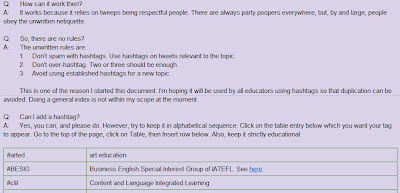
Twitter hashtags for educators: an index, at last!

If you're using Twitter, chances are that you are at least aware of hashtags, even if you don't use them. And if you do use them, no doubt, you've sometimes felt somewhat overwhelmed and confused. Part of the problem is it's a free-for-all concept. There's no official body to register hashtags and everyone can use any words as hashtags, and as many as they want.

Through time, nevertheless, regular tweeps (people who tweet) tend to stick to a few they use for their own interests but still feel at a lost to what unfamiliar ones mean. Worse, for me, is the duplication of tags and the long ones, especially when abbreviation is possible. Bear in mind that each tag eats up on the 140-character limit that Twitter has!

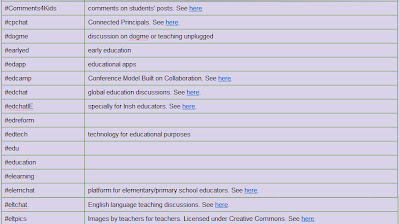
A recent confusion on a tag was the impetus I needed to create an index, unofficial as it may be. Whether it works depends on the will of others to keep it going. It's done on Google Doc, free for everyone to update. As long as it's not vandalised, I'll keep it public. My wish is that educators would start streamlining hashtags and mark unused ones as OBSOLETE or REPLACED BY... so that the community will grow even more.

What's your opinion? Will you start using it and let others know, too?

Twitter education hashtags index


Wednesday, 16 May 2012

Top 100 Language Lovers 2012 - Who are you voting for?

The Top 100 Language Lovers 2012 competition is on again! This year, there had been 935 nominations! A CLIL TO CLIMB has been included for voting in the language learning blogs category. There are four categories in all.

50% of the final score is based on user votes; the other 50% is based on Lexiophiles' judging team's criteria. If you have found this blog useful, your vote will be most appreciated!


Each person can vote once in all four categories.

  Vote the Top 100 Language Learning Blogs 2012

The voting phase started on May 15th, and ends on May 28th, 23:59 German time. Read more about the voting phase here.

The results will be published on May 31st.


Saturday, 12 May 2012

What would you do if...?

ELT ESL EFL CLIL Lesson plans images conversation dogme photos
Image by Chiew Pang
When I saw this...

At first, I just walked past. Later I thought, what if...

And I started fantasizing about the briefcase holding wads of crisp bills...

Then the language teacher ego took hold of me and said, hell, there's an awful lot of possibilities there for a conversation lesson, full of lexical challenges.

So, what would you do if you saw something like this? Ponder over it while I go back to my fantasies...

This image is part of the Project 366 series. If you're involved in it, (and if not, why don't you start?) please let us know in this Google Doc. My images are in Flickr, free for non-commercial use as long as they are properly attributed.

Sunday, 6 May 2012

How to stay healthy the cheap & easy way

Have you heard the quotation “A sound body makes for a sound mind”? Well, actually, I'm not sure if such a quote do exist, but the ancient Roman poet, Juvenal, did say

orandum est ut sit mens sana in corpore sano

which can be translated as

It is to be prayed that the mind be sound in a sound body.

The latest topic in iTDi's blog is "Staying healthy and motivated" - if you haven't seen it, I suggest you do it soon. However, most of the advice was centred on tips on how to stay motivated, so I thought I'd redress the balance ;-) and write about health here. After all, if the body isn't healthy, the mind struggles to remain sound.

Inadvertently, when one talks about health, two topics come to mind - that of exercise and diet.

This article is written with those who are more in the physically inactive rather than the active camp. So, if you're already physically on the ball, what I'm about to say may not be all new to you.

My ideas are very basic and can be started upon straightaway. No need to enrol in a sports club or gym, no need to seek an expert trainer. Just a slight change in your habits, that's all. However, I must say that these opinions are my own. If you haven't been active for a long time, I'd suggest going for a medical check-up first and make sure you're fit enough to do some physical activity.

Breathing

ELT iTDi CLIL health and motivation
Image by Chiew Pang
This is primordial, so primordial that most have forgotten how to do it! Right, you're probably thinking I've gone bonkers.

Many of us breathe too shallowly; and if I were to say, "Breathe deeply!" chances are that you'll inflate your chest to the maximum and struggle after a few seconds. Isn't that right?

Well, it is your stomach that you should be inflating, not your chest. The proper way to breathe is to use your stomach muscles, not your chest. Put your hand on your stomach and breathe - is it moving? Or does your chest move first?

Watch babies - they breathe the correct way. Naturally. In fact, there's one way to force yourself to breathe in the right manner. Lie face down and breathe. What do you notice? Your stomach moves, right? Now, stand up, and try to repeat it.

Whenever you remember, notice your breathing. Correct it. Take long deep breaths (with your stomach) instead of short gulps. Do it often until it becomes second nature. Just like to a baby.

The morning
Image by Malene Thyssen

What's your morning routine?

For as long as I can remember - and we're talking about 3 decades or so here - I follow a simple exercise routine. I must admit that the duration gets shorter and shorter as the muscles and the joints start complaining...

The morning is important as it sets your body (and the mind) up for the rest of the day. You don't have to hump and pump; just do light stretching and rotational exercises. You don't need to dedicate a lot of time either. 5 minutes is better than nothing.

Rotate all the joints: ankles, knees, hip, neck, shoulders, wrists...
Stretch gently - if you're too old to remember your PE classes ;-) try googling "stretching exercises".

Later on, when you're in better shape, you can add simple free-hand exercises such as sit-ups, squats and push-ups. Or you can do isometric exercises.

Notch it up

ELT iTDi CLIL health and motivation
Image by Chiew Pang
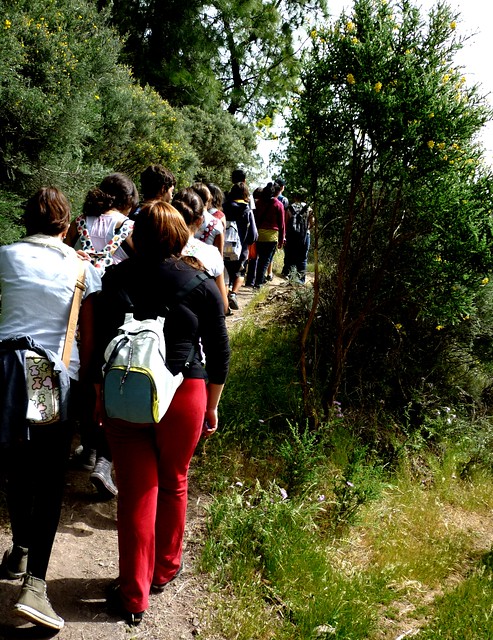
You've heard it, I'm sure - before jumping into your car, think "Can I walk instead?"

When you walk, just quicken your pace slightly. Feel your legs stride, your back strong, your breathing deep and regular (stomach moving!).

You've also heard this one before. Take the stairs. Do it! Start by walking down - it's often quicker than the lift anyway! Gradually, start walking up, too. If there are too many flights, do a few. Combine it with the lift.

Move on the escalators and the travelators; don't just stand still.

The premise is simple: move as much as you can, whenever you can. Your heart will be grateful to you for it.

Diet

ELT iTDi CLIL health and motivation
Image by Chiew Pang
Again, I go back to the morning. It's the most important part of the day. To break your fast, have a glass of water (at room temperature).

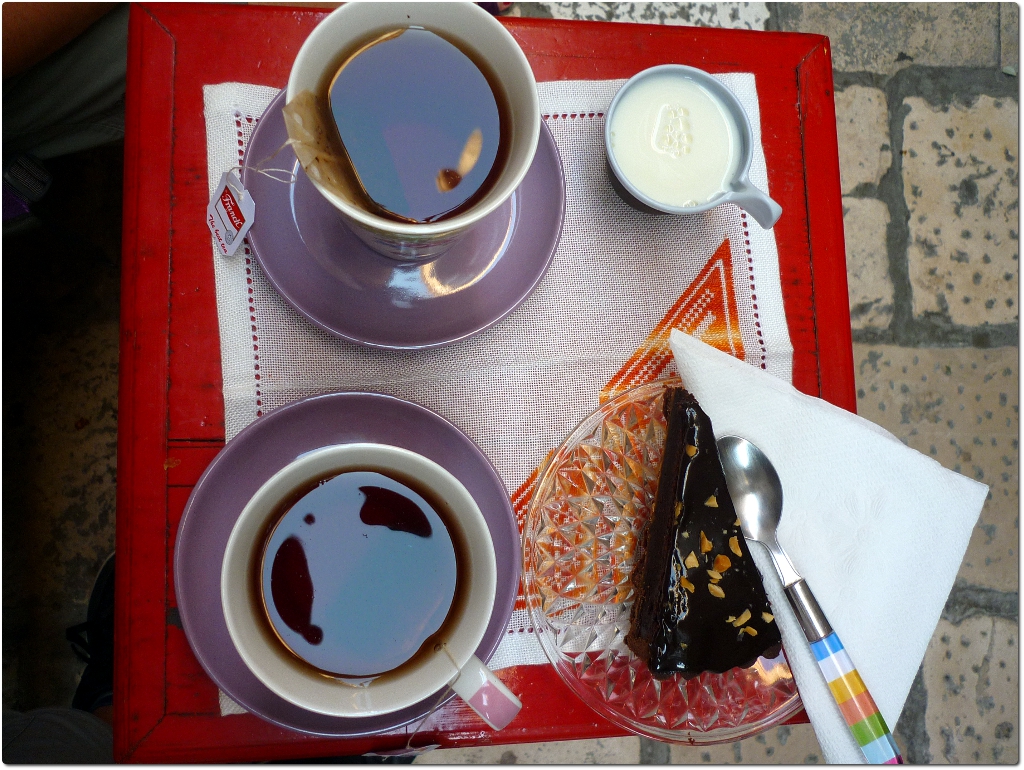
Then, you do your breathing and stretching exercises, and after that, you're ready for a nutritious breakfast! You need a high-energy, not a high-calorie, one. Carbohydrates, not fat; complex carbohydrate (like grains) not simple (like sugar). My breakfast usually consists of a steaming cup of tea and a bowl of muesli supplemented with a tablespoon of wheat bran, some yoghurt, a banana, some cornflakes, and soya milk.

As far as food is concerned, I'm sure you know the drill: less fat, more protein; lots of fruit and vegetables; less frying, more grilling and steaming. Go easy on the sugar, but a treat once in a while doesn't do anyone any harm! ;-)

ELT iTDi CLIL health and motivation
Image by Chiew Pang

Stay healthy! Stay motivated!


Saturday, 28 April 2012

Saturday Special for teachers by teachers


Today was a special day. Special for many reasons. Special because the world is full of dedicated teachers willing to give up their time to share their experience and expertise with others. Their willingness would not have come to anything if there wasn't anyone to give them a platform from which to shout. And all the shouting would not have come to any good if there wasn't anyone out there to listen.

So, Saturday, 28th of April, morning for some, evening for others, was special. A hundred or so educators sacrificed part of their weekend to listen to five dedicated females, Barbara Hoskins Sakamoto, Özge Karaoglu, Ann Mayeda, Penny Ur and Kate Cory-Wright, discuss "What do we know about language teaching and learning?".

I'm sure most, if not all, felt it was well worth their time. Were you there? What did you take away from the webinar? If you weren't, watch out for the next iTDi event!

We were missing some fast tweeps (Twitter users); I tried my best, but I was moderating at the same time. Here is a collection of the back-channelling going on. Many thanks to these back-channellers, the participants, the speakers, and all the organising team, including the generous Heike Philp of The Virtual Round Table fame.

  Get Microsoft Silverlight

To watch on full screen, click as shown in the image below.