Saturday, 28 September 2013

#RSCON4 Reform Symposium 11-13 Oct 2013: Useful links

I won't say much as I'm sure you must have read plenty about RSCON, the Reform Symposium. Instead, I'll place some useful links here because I know how, sometimes, it's difficult to find what you're looking for. If you are still in doubt regarding any aspect of this incredible e-conference, just get in touch with me.


Twitter Lists

Apart from following the hashtag #RSCON4, you may like to follow the people who are making it all possible. Subscribing to the lists is best because names may be added from time to time.


Spread the Word

Write about it in your blog. Wear a badge. Tweet it. Tell everyone in the social media scene.


If you've written a blog post, have it included here: http://goo.gl/KvplSP

If you're a presenter or an EdInspire nominee, you should have got a personal message about where to get the badge. Otherwise, get in touch with me.

If you know someone who deserves to be nominated for the EdInspire award, here's the form.

Main website: 


Prezi (courtesy of Chris Smith @shamblesguru): 


Pinterest:


Volunteers

Join up as a volunteer. Help us moderate. To make sure everything runs as smoothly as possible, we need more MODERATORS from all the time zones! Go here for more details: http://www.futureofeducation.com/page/call-for-rscon4-volunteer-moderators

Remember that even though you're a presenter, you can still moderate the other sessions!

Practice:

You can practise by signing up for a free WeCollaborate room: http://try.bbcollaborate.com/trial/register.go

Training sessions

The 2 official training sessions are over, but you can watch the recordings.

There are two - they are similar. The links are given at the end of this post.

When you click on either link, you'll be asked to save a file called nativeplayback.jnlp
Save it where you can find it easily, on your desktop, for example.
When it's finished saving, open it.
This will start the recording. It may take a few minutes to load.
Click on play to begin the playback.

The whole recording lasts for 76 minutes although you can fast forward or rewind it.

http://goo.gl/TSgd3I
http://goo.gl/fTv8zM

If you're still unsure about participating in webinars and need extra training, feel free to contact me for a private session.

Bookmark this page. If there's anything else that I think may be useful, I'll come back here and edit.

I look forward to meeting you all in a week's time!

Schedule


Scroll down and click on your time zone.

Saturday, 29 June 2013

Punctuation..? A review

A review of Thomas Bohm's Punctuation..?

Definition 


Macmillan defines it as “the use of marks such as full stops or commas in order to write in a clear style”.

Oxford's definition is slightly wordier:  “the marks, such as full stop, comma, and brackets, used in writing to separate sentences and their elements and to clarify meaning”.

Edgar Allan Poe, the 19th century American poet and writer has been quoted as saying “The writer who neglects punctuation, or mispunctuates, is liable to be misunderstood.... For the want of merely a comma, it often occurs that an axiom appears a paradox, or that a sarcasm is converted into a sermonoid.” (Source: Dictionary.com)

Yet, punctuation has caused endless debates over the years, and one of the main culprits is the apostrophe.

Apostrophe 


Serious “apostrophers” walk around with a marker, correcting signs and notices; websites and organisations, such as TheApostrophe Protection Society and Kill the apostrophe have been created; and in 2009, Birmingham City Council removed apostrophes from all its signs! (Source: TheTelegraph)

Do you know that there is even an International Apostrophe Day (18th Aug)?

So, when I was asked to review a little book on punctuation, it didn't take much to convince me.

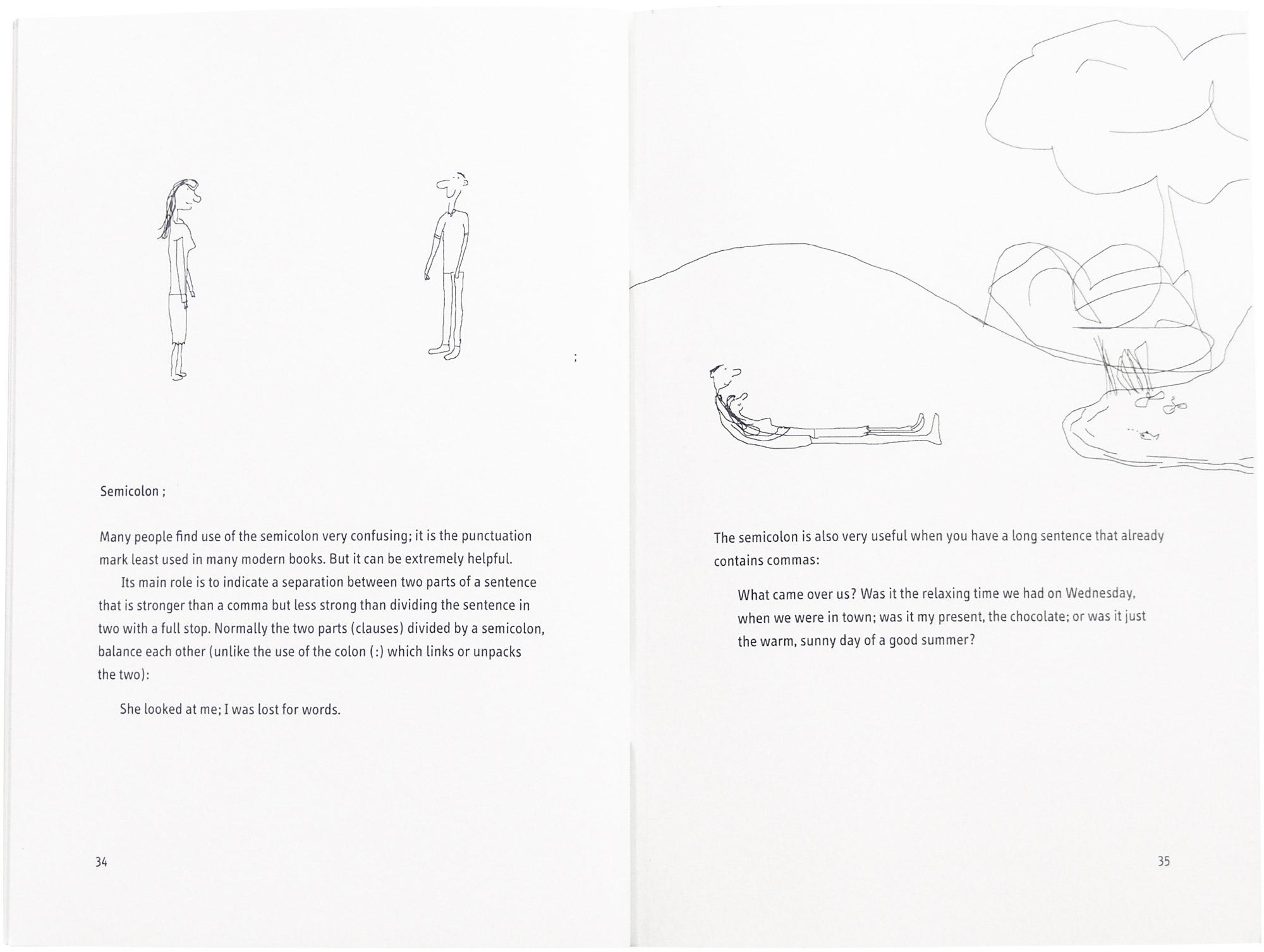
Simply titled, “Punctuation..?”, it is written by Thomas Bohm, who also did the childlike illustrations, adding a touch of wit to the otherwise dryish but clear explanations. The book is available in Central Books, Waterstones and Amazon.

“Punctuation..?” seeks to explain the functions and correct uses of 21 of the most used punctuation marks in alphabetical order, starting from the controversial apostrophe and ends with one of the most confusing for a lot of people – the semicolon.

Why does the apostrophe cause so much distress? Bohm says that the most common use of an apostrophe is to indicate possession although he didn't cite his source for such a conclusion. He's probably right but I can't help but think that it might be a close call with its use to show omission, eg can't, doesn't, etc.

What is more important, however, is Bohm's failure to mention what happens when the name of the person ends with an s, such as Dickens or Frances, or when talking about a singular noun which ends in s, eg class.
On the other hand, it is interesting that Bohm should mention “the apostrophe has largely vanished from company names”. Waterstones, for example, removed their apostrophe as recent as 2012!

Brackets 


Bohm mentions the round, curly and square brackets. Apparently, there are rules attached to them. Most of us, me included, use only the round brackets, but I sometimes use a different one if I need brackets within brackets and I also use the square brackets to denote if a verb is transitive or intransitive, or if a noun is countable or uncountable, as in the dictionaries. The curly brackets are supposedly for showing “a series of equal choices” whatever that means and square brackets are for showing a different tone or to clarify information.

The rest... 


Aside from the use of brackets, Bohm insists that the dash, the em dash and hyphen are all different. There is also something called interpunct, which is a small dot vertically centred between words. I don't know where to find this on my keyboard.

Bohm also states that the double quotation marks are reserved for quotes within quotes and the single are now mainly used.

I'm not too sure about this because I still see double quotes everywhere.

Conclusion 


As you notice, there are bits of interesting information scattered about in this booklet; some, you may know while others may come as a surprise. Rules about the usage of punctuation are readily available on the Net, but if you are one of those who prefer a hard copy at hand, I can heartily recommend this book. It's handy and small (35 pages) and does well what it sets out to do. I can't help but think, however, that an e-book version would serve as a better vehicle.


Thursday, 18 April 2013

How do you teach English?

Kaplan surveyed more than 500 ESL teachers from around the world to discover what tools they use to enhance their lessons. Here's an infographic they created to show the results.

Which do you use?


elt efl ell esl clil How to teach English

Saturday, 13 April 2013

Confusing words: Whether or if?

"Police are probing WHETHER the deaths of a woman, 107, and her daughter are a murder and suicide." (The Mirror, 12 Apr 2013)

" 'I didn't know WHETHER to laugh or cry'- Twitter responds to Lindsay Lohan on Charlie Sheen's Anger Management." (The Independent, 12 Apr 2013)

Image by Chiew Pang. Copyright 2012
I don't know whether or not I should...
 
There are often doubts regarding the use of "whether", especially among learners up to B1 level.

WHETHER /ˈwɛðə/ is a conjunction used when we're expressing a doubt or choice between alternatives.

In indirect questions which expect a yes/no answer, we can either use whether or if.

I asked them whether/if they were going to take the exams in June.


If or appears later in the sentence, we generally prefer whether, although if is also possible.

They weren't sure whether/if she was telling the truth or not.  

Whether and not if is used in the following conditions:

Before an infinitive 

They can't decide whether to take the exams in June.

After a preposition

The students were unsure about whether the teacher's explanation was helpful. 

Immediately before "or not"

I'm not sure whether or not the students are ready.  

Contrast with: I'm not sure whether/if the students are ready or not. 

Spelling 

Don't confuse the spelling of the conjunction whether with the noun weather. 

Both are pronounced the same: /ˈwɛðə/


Sunday, 10 March 2013

Friday, 2 November 2012

Breaking rules with John Fanselow


iTDi is a community of international teachers who work together to help other teachers from all around the world. Membership is free, and they offer regular free webinars (online conference), forum and courses.
Next week they have a special course, as you can see from the above poster, imparted by John F Fanselow, quite a character, I can tell you! If I were you, I wouldn't miss it. You can read the details on the poster, so there isn't any need for me to repeat it. The direct link for the course is: http://itdi.pro/itdihome/breakRules.php

Now, the good news. If you register through the iTDi site, the cost is US$99, approximately 80€. If you're based in Spain, I have a special offer for you (we all know about the crisis!). You'll have to register through me though. Payment can be made via Paypal or bank transfer. Paypal is easier and quicker. Paypal charges no fee to transfer money. If you don’t have a Paypal account yet, you can set one up free at https://www.paypal.com. However, you don’t need to have a Paypal account to send money via Paypal. All you need is an international credit card.

Do hurry as I can only keep this offer open until 9th November! Spread the news to your fellow teachers! Email me at acliltoclimb@gmail.com for further enquiries.

Tuesday, 4 September 2012

Voice #237 on an edventure

Once in a while someone catches me off-guard and this is one of those times. Anthony Salcito, Vice President of Worldwide Education at Microsoft, runs a personal blog, www.dailyedventures.com, where he speaks to "heroes in education worldwide".

Each day the blog features an interview with someone in the education sector: "teachers, school leaders, policy-makers, business leaders, celebrities, NGO leaders, researchers - people who have embraced enhancing education as a core facet in their lives." Anthony tries to find out who these people are, what inspires them, what frustrates them, and what hopes they hold for the future of education.

So, when I was contacted to participate, how can I possibly refuse, right?

You can read about the interview here.