Friday, 22 October 2010

Plurals Spelling rules + Games


Regular Plurals

The plural of most nouns are formed by adding 's' at the end of the singular noun: cup - cups, snake - snakes, bicycle - bicycles. However, there are some special cases.

We add 'es' to nouns that end in s, x, z, ch, or sh.

bus - buses
box - boxes
waltz - waltzes
match - matches
brush - brushes

We also add 'es' to nouns ending with o.

echo - echoes
tomato - tomatoes
potato - potatoes
hero - heroes

However, not all nouns ending with o have an -es ending.

For nouns ending in a vowel + o, we just add an s.

kangaroo - kangaroos
radio - radios
zoo - zoos

The following words also have just an s added. Most 'new' words also follow this rule.

commando - commandos
concerto - concertos
Eskimo - Eskimos
kilo - kilos
logo - logos
photo - photos
piano - pianos
solo - solos
soprano - sopranos

Some words ending with an o can have either s or es added.

tornado - tornados, tornadoes
mosquito - mosquitos, mosquitoes
volcano - volcanos, volcanoes

For nouns ending in a consonant + y, we remove the y and add ies.

baby - babies
city - cities
ferry - ferries
lady - ladies
party - parties
strawberry - strawberries

However, if the y is preceded by a vowel, we just add an s.

holiday - holidays
monkey - monkeys
boy - boys

Irregular plurals

For irregular nouns ending in f or fe, we remove the f or fe, and add ves.

calf - calves
half - halves
knife - knives
leaf - leaves
thief - thieves
wife - wives
loaf - loaves

Some nouns ending in f are considered regular.

belief - beliefs
cliff - cliffs
proof - proofs

These nouns below, mostly of old English origin, are irregular plurals that do not follow the other spelling rules. The plurals have a different vowel sound from its singular version.

foot - feet
goose - geese
man - men
mouse - mice
person - people
tooth - teeth
woman - women

Some nouns referring to groups of animal have the same singular and plural form.

bison - bison
deer - deer
moose - moose
salmon - salmon
sheep - sheep
trout - trout

Words of foreign origin have special plurals, which generally follow the original rules.

analysis - analyses
bacterium - bacteria
cactus - cacti
fungus - fungi
criterion - criteria
medium - media


Here are some games for you to practise. These games have been designed to be played more than once if you want to reap the benefits. The objective is to keep on improving your scores, and you will learn the plural forms even if subconsciously.

Chiew's EFL ESL CLIL Blog: English Plurals Explanation and Games
 Arcade Game: shoot the plural form!
The list of nouns changes each time you play a new game!


Chiew's EFL ESL CLIL Blog: English Plurals Explanation and Games 
Point and click the regular plural form
Chiew's EFL ESL CLIL Blog: English Plurals Explanation and Games
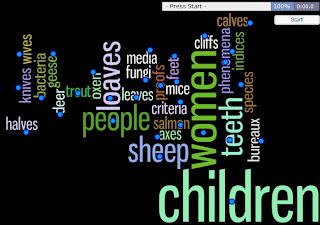
 Point and click the irregular plural form


Thursday, 21 October 2010

ProProfs Quiz Maker Review + Regular Past Simple Pronunciation Quiz


Being a strong advocate of a paperless classroom, I am constantly on the lookout for good tools to help us achieve that goal. Frequent readers of this blog would have seen me used various sites and software to create my online activities. Today, I would like to share ProProfs with you. An example of a quiz I'd made with ProProfs can be seen here: World Cup 2010 Trivia, and another one at the end of this post.

Like a lot of commercial software and web-based services, there is a free version and a paid version. The good news is that, for educational purposes, the paid version now costs only $2.97 per month! The additional features you will get for the paid version are a tracking service on who took your quiz, no advertisements, a quiz analytics, and the ability to store, view and download quiz results.
Chiew's CLIL EFL ESL Blog: ProProfs Quiz Maker Review

Chiew's CLIL EFL ESL Blog: ProProfs Quiz Maker Review

Chiew's CLIL EFL ESL Blog: ProProfs Quiz Maker Review

Chiew's CLIL EFL ESL Blog: ProProfs Quiz Maker Review

You can also opt for the option for an email to be sent to you each time someone takes your quizzes.

There are two types of quiz you can create with ProProfs: a scored quiz where each question has a right or wrong answer, or a personality quiz where there are no right or wrong answers.

The scored quiz gives you 5 different choices: multiple choice, checkboxes, true/false, fill-in-the-blanks, and essay type questions.

You are allowed to mix different types of questions in your quiz. Videos and images can be added, but not plain sound files. In multiple choice, more answers can be added to the default of 3. How many? More than you'd ever need!

Embedding the quiz in your website is also very easy, with options to customise it to your own liking. You may edit your quiz whenever you like, but be aware that editing it will reset all statistics to zero.

My verdict: If all you need is a simple multiple choice type of quiz, ProProfs is easy to use, and it's cheap. I would like to see more variety added, e.g., matching type questions (word to word and word to image), and the ability to preview and save the quiz before publishing it would be nice. As quiz makers would know, we sometimes need a break, or we run out of inspiration, or the PC crashes... All it would need are separate buttons to preview, save and publish. As it is at the moment, I would have to mark a partial quiz as private, and use the submit button to save it. When I'm ready to publish it, I'd just have to remember to flag it as public again.

Another little thing I find lacking is a question number! It's rather annoying to have to keep on scrolling up and counting how many questions you've created. Just to show you how important this is, I had intended to prepare 15 questions for the quiz below, and I could have sworn I counted 15!

Here's a sample quiz I prepared. If you like this quiz, you may also like this: http://aclil2climb.blogspot.com/2009/10/pronunciation-of-regular-past-simple.html


Tuesday, 19 October 2010

Basic Art Material

Last Updated: 01 Nov 2010
A better view of the presentation can be seen here: http://aclil2climb.blogspot.com/2010/11/basic-art-material.html

First and foremost, please let me remind you that what you see here and on Scribd and Slideshare, is only a review. These reviews do not show animations. If you see this presentation without the animations, you'll just see images and words overlapping each other, and it will just look like something done by someone not knowing what he is doing!

So, if you want to see this, please make sure to download it as a PowerPoint show. This  show can also be downloaded from Scribd.

The idea is for it to be used either for teaching basic art material as new vocabulary or for revision.

Each slide is introduced by an image. Prompt the students for the name, and/or the description. The image is followed by the definition, and sometimes by a different image of the same object. Finally, the name is displayed. Where the words are very easy, the definition is displayed before the image.

Don't forget to look at the online game for this lesson: http://aclil2climb.blogspot.com/2010/09/art-material-tagging-game.html


For those who prefer non-ICT activities, below are 24 pictures of material we have seen in the PowerPoint show. These pictures can be used as flashcards for classroom games such as bingo, for example. See my post for Instant Bingo.

This set of pictures is also available in José Alberto's Slideshare account.

Basic Art Material Flashcards

Sunday, 17 October 2010

Vowel letter pronunciation for beginners


A lot of Spanish learners (and, no doubt, other Latin learners, too) have problems pronouncing the vowels (a, e, i, o, u) correctly. Often, they either pronounce it as in their own language, or they confuse letters, especially e with i. Last year, José Alberto, from IES Los Tarahales, and I were working on a chart to hang on the classroom wall to help the children remember the right pronunciation. Although pronouncing vowels doesn't really help with general pronunciation, it is very important when they are asked to spell words, or when words are spelled out to them.

Unfortunately, we never did quite finish the chart in time. Although not perfect, we're sharing it here now in case some of you need something like it for your classroom. The same document is also available in José's Slideshare space.

Vowel Letter Pronunciation

Sounds of English: Tournament!

Regular readers among you will know that I use Purpose Games quite a lot, mainly for point and click activities. Members create regular tournaments, so I decided to start one of my own on none better than the Sounds of English. There are 6 games in the tournament. Even If you haven't got much knowledge on phonetic symbols, don't worry! These games will help you learn them. One of the games isn't very good as the clues include phonetic transcriptions which Purpose Games hasn't been able to handle, but you'll be able to guess them after playing it a couple of times.

Please note that you'll have to be a member of Purpose Games before you can participate in the tournament. Membership is completely free.


C'mon! Join in the fun and learn at the same time!
Oh, one more thing - you can play the games as many times as you wish to keep on improving your scores.

Saturday, 16 October 2010

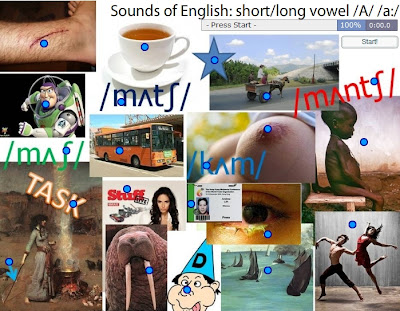
Sounds of English, short vs long vowel /ʌ/ /ɑː/

Chiew's CLIL EFL ESL Blog: Sounds of English

Here is the next game on the sounds of English series. This is to practise the short vowel /ʌ/ and the long vowel /ɑː/.

Click on the image above to begin the game. Try as many times as necessary for you to get 100% right. This is slightly more challenging than the previous one.

If you want to see your name appear on the scoring sheet, you'll have to register before playing. Remember your nickname & password for all my other games which are hosted on Purposegames.


Look under the category English Sounds for more pronunciation activities.

Sounds of English, short vs long vowel /ʊ/ /u:/

Chiew's CLIL EFL ESL Blog: Sounds of English

More on the sounds of English. This is to practise the short vowel ʊ and the long vowel u:

Click on the image above to begin the game. Try as many times as necessary for you to get 100% right. This should be easy compared to some of the others on this ongoing series.

If you want to see your name appear on the scoring sheet, you'll have to register before playing. Remember your nickname & password for all my other games which are hosted on Purposegames.

Either way, please leave a comment, stating your score (percentage and time).

You may also like these:

Short vs Long Vowel I and i:
Rhyming Slang Game
Rhyming Words Game
Pronunciation of Regular Past Simple
Cockney Rhyming Slang

Look under the category English Sounds for more pronunciation activities.